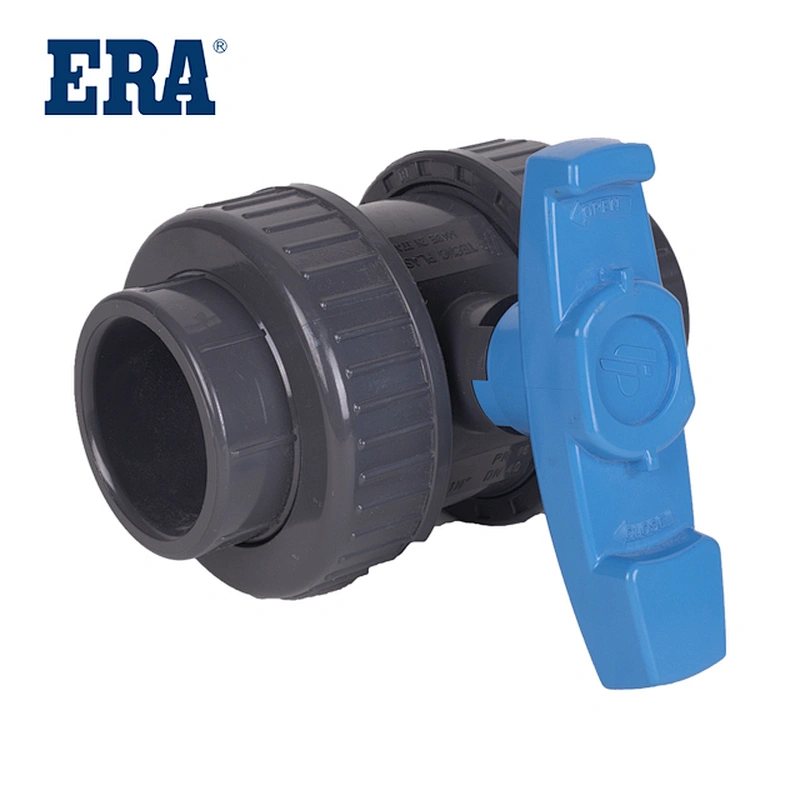
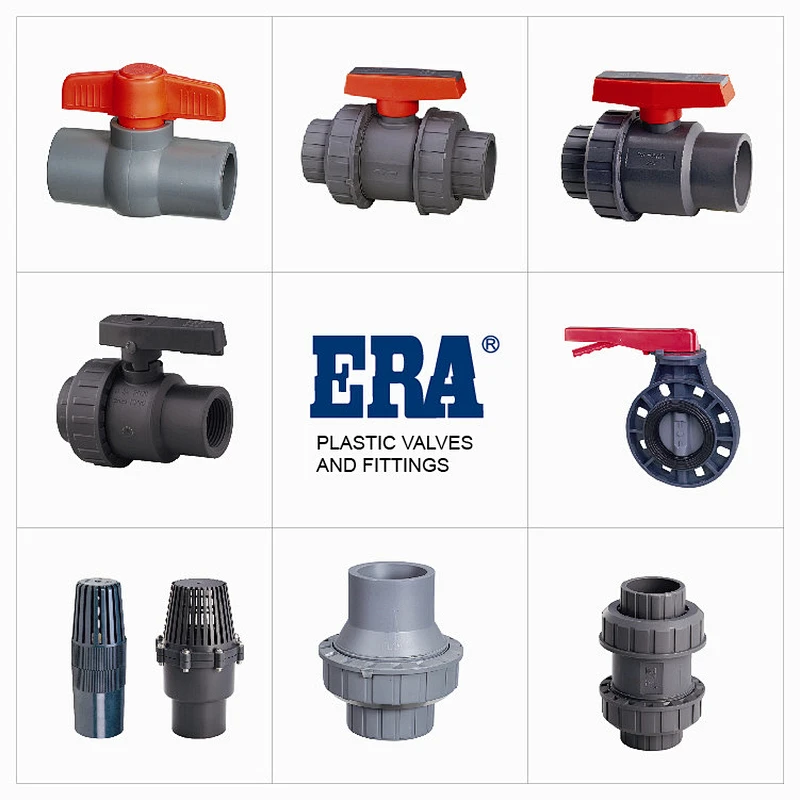
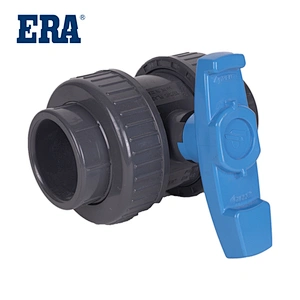
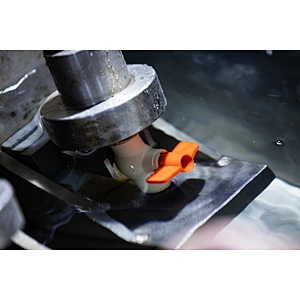
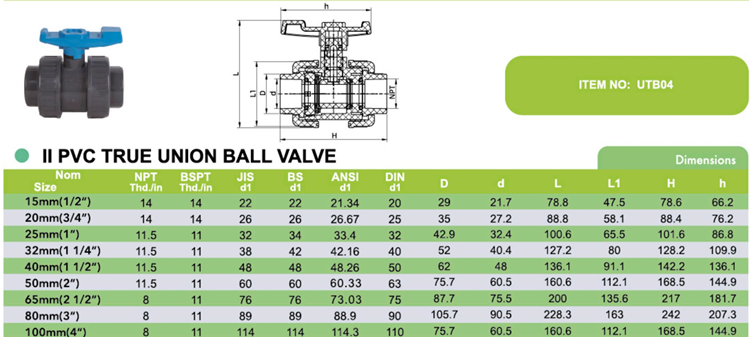
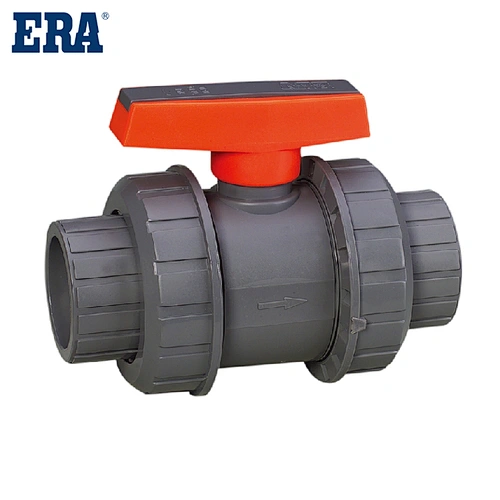
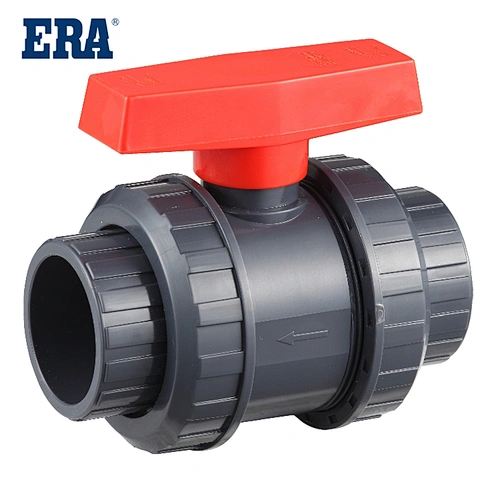
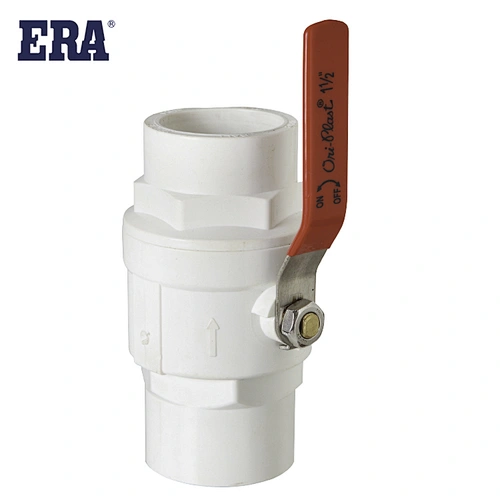
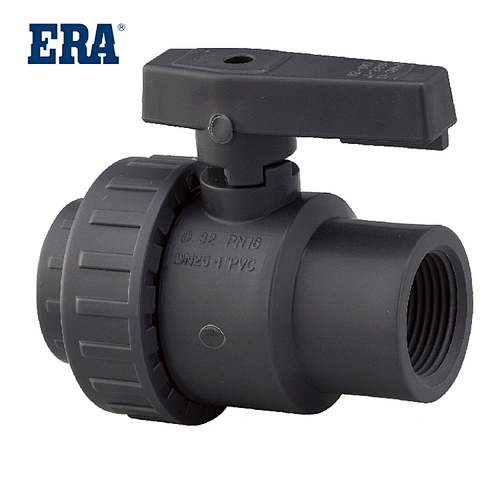
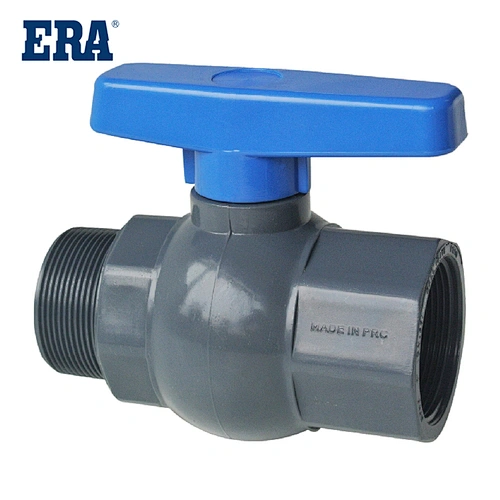
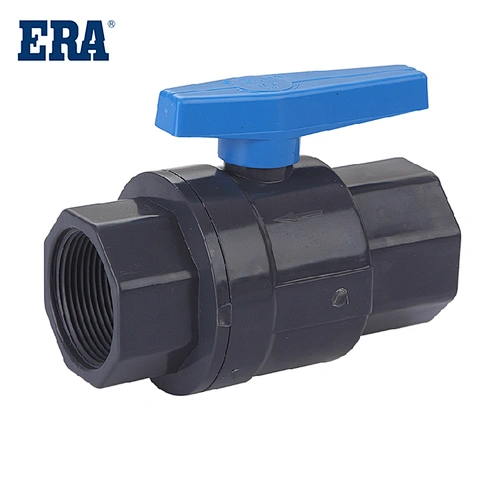
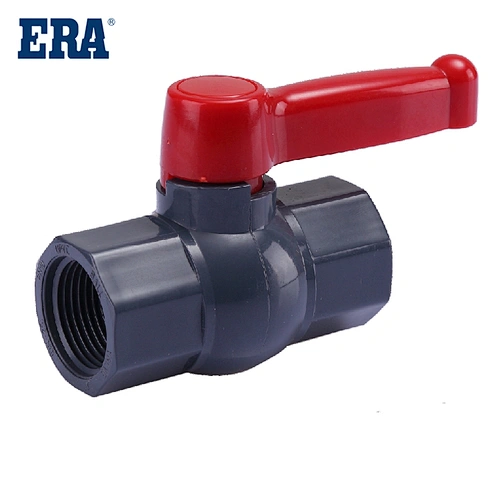
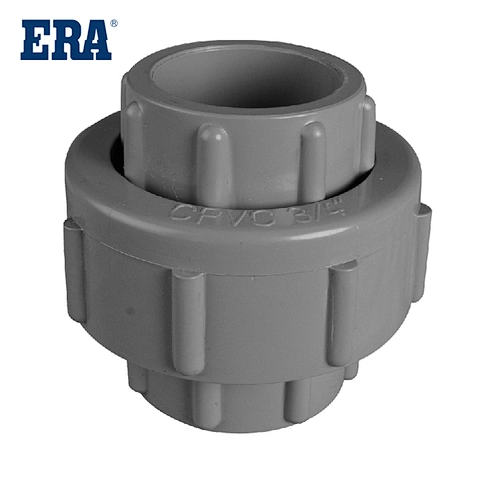
ERA Valves, II PVC True Union Ball Valve , UTB04 , PN10 (F1970), NSF-pw & UPC pvc union ball valve
PVC valves shall conform to ISO 4422-4. ASTM F1970-05. CPVC valves shall be manufactured as a system and be the product of one manufacturer.
Excellent flow characteristics. Seats: PTFE. Seals: EPDM. Suitable for hot water systems.
| Model Number | UTB04 | Material | PVC |
| Description | II PVC TRUE UNION BALL VALVE | Standard | F1970 |
| Temperature | Max 82.2°/180°F | Working Pressure | PN10 ,10Bar,1.0Mpa |
| Size | 1/2''-4'' | Certificate | NSF/UPC |
| Connection | Socket or Thread | Color | Light Grey |
Main Product:
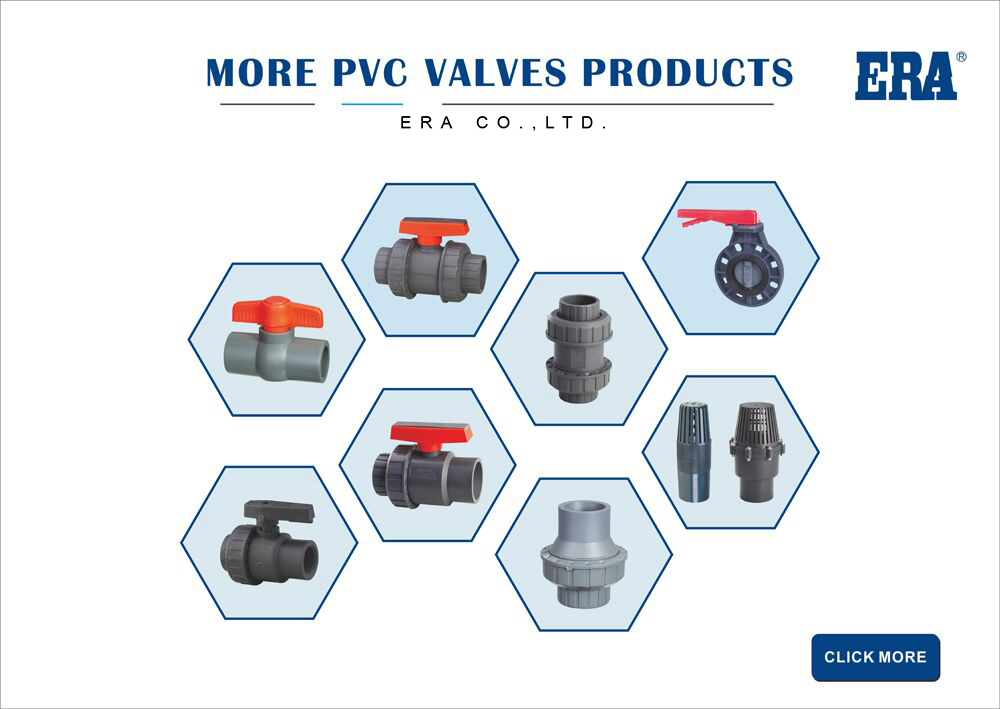
The ball valve is a common fluid control device, and its working principle isThe ball valve is a common fluid control device, and its working principle is to control the flow of fluid by rotating the ball. The main characteristics of the ball valve are simple structure, small size, light weight, easy installation, as well as good sealing performance and corrosion resistance.
The structure of the ball valve mainly includes the body, ball, stem, and actuating device. The body is the main part of the ball valve, usually made of cast iron, stainless steel or plastic materials. The ball is the core component of the ball valve, usually made of metal materials such as stainless steel, copper, aluminum, etc. The stem is the part that connects the ball and the actuating device, usually made of metal materials. The actuating device can be a manually operated handle or an automatic actuating device such as electric, pneumatic or hydraulic.
The working principle of the ball valve is: when the ball rotates 90 degrees, the fluid can pass through the valve; when the ball rotates 180 degrees, the fluid is cut off. This switching method makes the ball valve have the characteristic of quick opening and closing, which is suitable for occasions that require frequent switching.
Classified by purpose and function:
Block valves: gate valves, globe valves, ball valves, disc valves, plug valves, diaphragm valves. Check valves: check valves
Regulating valve category: pressure reducing valve, pressure regulating valve, throttle valve
Classified by working temperature: high-temperature valve, medium temperature valve, normal temperature valve, low-temperature valve, ultra-low temperature valve. Classified by pipeline connection method: flange connection, welding connection, threaded connection, etc
The advantages of the ball valve are mainly as follows:
1. Simple structure, small size, light weight, and convenient installation and maintenance.
2. Good sealing performance, can prevent fluid leakage.
3. Due to the curved surface shape of the ball, the resistance generated by the fluid passing through the valve is small, and the fluid loss is small.
4. Due to the high hardness of the ball, it has wear resistance and long service life.
5. Different materials and sealing methods can be selected according to different working conditions and environmental requirements.
The disadvantages of the ball valve are mainly as follows:
1. Due to the curved surface shape of the ball, there will be some noise when the fluid passes through the valve.
2. Not suitable for regulating flow rate, only for fully open or fully closed occasions.
3. If the valve is in a semi-open state for a long time, friction may generate heat, causing sealing surface wear.
The ball valve is a common fluid control device that is widely used in various industrial, residential, and commercial fields. It controls the flow of fluid by rotating a ball, and has the advantages of simple structure, small size, light weight, and easy installation. The emergence of the ball valve has brought many conveniences to people's lives, and here are some specific examples:
1. Industrial applications: In industries such as chemical, petroleum, pharmaceuticals, and food production, ball valves are widely used for the transportation and control of liquids, gases, and steam. They can quickly open and close, adjust flow rates, and ensure the stability and safety of the production process. At the same time, ball valves have good sealing performance, which can prevent leakage and contamination, protect the environment and personnel safety.
2. Domestic applications: Ball valves are also widely used in homes. For example, in the kitchen, ball valves are used to control the flow rate and pressure of tap water; in the bathroom, they are used to control the temperature and flow rate of shower water; in the garden, they are used to control the flow of irrigation systems. These applications make domestic life more comfortable and convenient.
3. Commercial facilities applications: In shopping malls, hotels, office buildings and other commercial facilities, ball valves are used for fluid control in air conditioning systems, heating systems, water supply systems, etc. They can accurately regulate flow rate and pressure to ensure the normal operation of equipment and energy conservation. At the same time, the quick opening and closing function of ball valves also makes maintenance and repair more convenient and fast.
4. Public facility applications: In urban water supply and drainage systems, ball valves are widely used. They can quickly open and close, adjust water flow, prevent floods and backflow of sewage. At the same time, the sealing performance of ball valves can also prevent pipeline leakage and ensure the safe operation of public facilities.
In summary, as a common fluid control device, the ball valve brings many conveniences to people's lives. Its emergence makes industrial production more efficient and safe, domestic life more comfortable and convenient, and the operation of commercial facilities and public facilities more stable and reliable. With the continuous progress and development of technology, it is believed that ball valves will play a greater role in future applications.
The production and installation process of ball valves mainly includes the following steps:
1. Preparation work: Firstly, it is necessary to ensure that the pipeline at the installation position is in coaxial position, and the two flanges on the pipeline should remain parallel. At the same time, it is also necessary to confirm whether the pipeline can bear the weight of the ball valve itself. If it is found that the pipeline cannot bear the weight of the ball valve, appropriate support should be provided for the pipeline before installation. In addition, it is necessary to clean impurities, welding slag, oxide skin and other substances inside the pipeline to ensure the quality and safety of ball valve installation.
2. Assembly of ball valve components: The ball valve is mainly composed of studs, nuts, wrenches, stems, pressure sleeves, sealing rings, valve bodies, bonnets and valve cores. These components need to be assembled according to certain assembly relationships and technical requirements. The assembly drawing is the basic basis for the machine to carry out assembly, and it is also an important reference material for installation, commissioning, operation and maintenance of machines or components.
3. Installation of ball valve: Install the pre-assembled ball valve into the pipeline, paying attention to the direction of the ball valve, generally pointing to the flow direction of the medium. Then tighten the ball valve handwheel clockwise with a wrench to make it tightly connected to the pipeline.
4. Inspection and testing: After installation, pressure testing is required to check if there is any leakage in the ball valve. If there is leakage, it is necessary to re-tighten or replace sealing rings and other parts.
If the ball valve in the pipeline is broken, the following measures should beIf the ball valve in the pipeline is broken, the following measures should be taken to solve the problem:
1. Close the upstream and downstream valves to cut off fluid flow.
2. Remove the broken ball valve and clean the impurities, welding slag, oxide skin, and other substances inside the pipeline.
3. Select an appropriate ball valve according to the material and specifications of the pipeline for replacement.
4. Install the new ball valve, paying attention to the correct direction, generally pointing to the flow direction of the medium.
5. Open the upstream and downstream valves to restore fluid flow.
6. Conduct pressure testing to check if there is any leakage in the new ball valve. If there is leakage, it is necessary to re-tighten or replace sealing rings and other parts.
The ball valve is a widely used type of valve that is popular due to several advantages:
1. Low fluid resistance, practically 0.
2. It is not easy to get stuck during operation (in the absence of lubricants), so it can be reliably used in corrosive media and low-boiling liquids.
3. It can achieve complete sealing within a large pressure and temperature range.
4. It has the least flow resistance.
5. Compact structure, small size, light weight, fast opening and closing, easy to operate.
6. It has two sealing surfaces, and the sealing surface material of the ball valve is widely used for various plastics, which can achieve complete sealing.
7. The raised face of the ball body and the valve seat are isolated from the medium when fully open and closed, so high-speed substances passing through the valve are less likely to cause corrosion of the raised face.
8. The valve body is symmetrical, especially in the case of electric welded valve body construction, it can withstand stress from the pipeline very well.
Therefore, due to its excellent performance characteristics, the ball valve is widely used in industries such as petroleum, natural gas, chemical industry, etc., especially in situations where quick opening and closing are required, its advantages are even more prominent.
Development History of Chinese Ball Valves
The ball valve, also known as the ball-shaped valve, is aThe ball valve, also known as the ball-shaped valve, is a new type of valve developed based on the plug valve. Its main feature is a spherical body with a central through hole as the opening and closing component of the valve, with two non-metallic or metallic sealing seats on both sides, all contained within a valve housing. By driving the valve stem, the ball can rotate 90 degrees to achieve the "open" and "close" functions of the valve.
In China, the application of ball valves is very extensive, especially in industries such as petroleum refining, long-distance pipeline transportation, chemical industry, papermaking, pharmaceuticals, water conservancy, electric power, municipal administration, and steel manufacturing. In the mid-20th century, China's valve industry began to rise. For example, Shenyang Chengfa Ironworks relocated its factory to Beierma Road in Tiexi District in 1939 for expansion, with main products including large-capacity boilers and cast copper valves, with underground cast iron gate valves below DN800 in nominal size.
Overall, China's ball valve manufacturing industry has experienced a process of development from scratch to becoming an indispensable part of the national economy.
As an important fluid control device, the future developmentAs an important fluid control device, the future development prospects of ball valves are very broad. The following are some possible trends:
1. Intelligentization: With the development of technologies such as the Internet of Things, big data, and artificial intelligence, ball valves will become more intelligent. For example, real-time monitoring of the valve's working condition can be achieved through sensors, and predictive maintenance can be realized by analyzing data to predict valve failures. In addition, remote control and automation technology can be used to achieve automatic valve switching and adjustment.
2. Environmental protection: With the improvement of environmental awareness, ball valves will also pay more attention to environmental protection. For example, valves can be made from more environmentally friendly materials to reduce their impact on the environment. In addition, energy consumption can be reduced by optimizing design and improving processes.
3. Customization: With the diversification of user needs, ball valves will also become more customized. For example, valves with special functions can be designed and manufactured according to specific user needs. In addition, one-stop services including design, manufacturing, installation, and maintenance of valves can be provided.
4. High performance: With the progress of technology, the performance of ball valves will continue to improve. For example, the corrosion resistance and wear resistance of valves can be improved by improving materials and processes. In addition, the sealing performance and flow control performance of valves can be improved through optimized design.
Basic knowledge of ball valves
A ball valve is a valve that uses a sphere as the opening and closing element. With the rapid advancement of processing technology, detection technology, and intelligent control technology, as well as the continuous development of various new sealing materials
Emerging, ball valve products will be increasingly widely used. At present, ball valve products are not only applied in general industrial pipelines, but also in the West East Gas Pipeline and Coal to Oil Engineering projects
And it has been widely used in the transportation pipelines of nuclear and aerospace industries.
As early as the 1880s, the United States began designing ball valves, but the lack of appropriate sealing ring materials at that time limited the development of ball valve products. Until the 1950s
The emergence of elastic sealing materials such as polytetrafluoroethylene and the development of the machine tool industry have brought about a turning point and rapid development of ball valve products.
Ball valve structure and terminology
A ball valve is mainly composed of a valve body, valve seat, ball, valve stem, handle (or other driving device). The main function of a ball valve is to cut off or connect the fluid channel in the pipeline, and its working principle is simple: by using the handle or other driving device to apply a certain torque to the upper end of the valve stem and transfer it to the ball, rotate 90 ℃, make the channel of the ball coincide or be perpendicular to the centerline of the valve body channel, and complete the full opening or full closing of the ball valve.
The function of ball valves
A ball valve is a valve in which the opening and closing part (ball) is driven by the valve stem and rotates around the axis of the valve stem. Mainly used to cut off or connect media in pipelines, and can also be used for fluid regulation and control
Ball valves are suitable for:
1. The nominal diameter ranges from 8mm to 1200mm
2. The nominal pressure ranges from vacuum to 42MPa. 3. The working temperature ranges from -204 ℃ to 815c
Due to the fact that ball valves typically use rubber, nylon, and polytetrafluoroethylene as seat sealing ring materials, their usage temperature is limited by the seat sealing ring material. The cut-off function of a ball valve is achieved by pressing the metal ball against the plastic valve seat under the action of the medium (floating ball valve). Under a certain contact pressure, the valve seat sealing ring undergoes localized elastic-plastic deformation. This deformation can compensate for the manufacturing accuracy and surface roughness of the ball, ensuring the sealing performance of the ball valve. Due to the fact that the valve seat sealing ring of a ball valve is usually made of plastic, when selecting the structure and performance of a ball valve, the fire resistance and fire prevention of the ball valve should be considered, especially in departments such as petroleum, chemical, and metallurgy. When using ball valves in equipment and pipeline systems with flammable and explosive media, fire resistance and fire prevention should be given more attention.
Usually, in pipeline systems with dual position adjustment, strict sealing performance, mud, wear, contraction channels, rapid opening and closing action (1/4 turn opening and closing), high pressure cutoff (large pressure difference), low noise, air pockets and gasification phenomena, small leakage to the atmosphere, low operating torque, and low fluid resistance, it is recommended to use ball valves.
Ball valves are also suitable for pipeline systems with lightweight structures, low pressure cutoff (small pressure difference), and corrosive media.
Ball valves can also be used in low-temperature (cryogenic) equipment and piping systems. In the oxygen pipeline system of the metallurgical industry, ball valves that have undergone strict degreasing treatment are required. When the main pipeline in oil and gas pipelines needs to be buried underground, full bore welded ball valves should be used. When requiring adjustable performance, a specialized ball valve with a V-shaped opening should be selected. In petroleum, petrochemical, chemical, power, and urban construction, metal to metal sealed ball valves can be selected for pipeline systems with operating temperatures above 200 ℃.
Advantages and disadvantages:
PVC ball valves have the following advantages
1. Easy maintenance: Due to its simple structure and fewer parts, it is relatively easy to maintain.
2. Corrosion resistance: PVC ball valves have strong corrosion resistance due to the use of PVC material.
3. Low price: Compared to other types of valves, PVC ball valves are relatively cheaper and more cost-effective.
However, PVC ball valves also have some drawbacks:
1. Temperature limit: PVC material has a certain temperature limit and cannot withstand high or low temperatures.
2. Pressure limitation: Due to its simple structure, it cannot withstand excessive pressure.
Applicable scope
PVC ball valves are suitable for the following situations:
1. Water treatment industry: Due to its good corrosion resistance and low price, it is widely used in the water treatment industry.
2. Chemical industry: In the chemical industry, various chemicals are often used for production and processing, and PVC ball valves are a type of valve that can effectively resist chemical erosion.
3. Agricultural irrigation: In the field of agricultural irrigation, PVC ball valves can be used to control the water flow rate in irrigation pipelines.
FAQ:
1.What is your MOQ?
Our MOQ is usually 5 CTNS.
2.What is your delievery time?
The time of delievery is around 30-45days.
3.What is the shipping port?
We ship the goods via Ningbo or Shanghai port.
4.What is your payment terms?
We accept 30% T/T in advance,70% in the period of shipment or 100% L/C.
5.How should I contact you?
You can contact us with Trade Manager or send us an email by click Contact Supplier bottom.
6.What is the location of your company?
Our company is located in the Taizhou Zhejiang Province,China.
If you would like to have a visit, you are much welcome.
7.How about the samples?
We could send you the samples ,most samples are free to send to most places in China.If sent to other countries,transport fee shoule be paid by you.
8.Why choose us?
1 Genuine produces with excellent quality and competitive price.
2 Cooperating with the customers all over the world and knowing the markets very well.
3 ERA is a listed company. Everything can be rest assured working with us.
4 After- Services will be highly-satisfied. Any problems and feedbacks will be answered in a short of time.
Our Services:
1. Any inquiries will be replied within 24 hours
2. Professional manufacturer.
3. OEM is available.
4. High quality, standard designs, reasonable&competitive price, fast lead time.
5. Faster delivery: Sample will be prepared in 2-3days.
6. Shipping: We have strong cooperation with DHL, TNT, UPS, MSK, China Shipping, etc.
7. You can also choose your own shipping forwarder.


 English