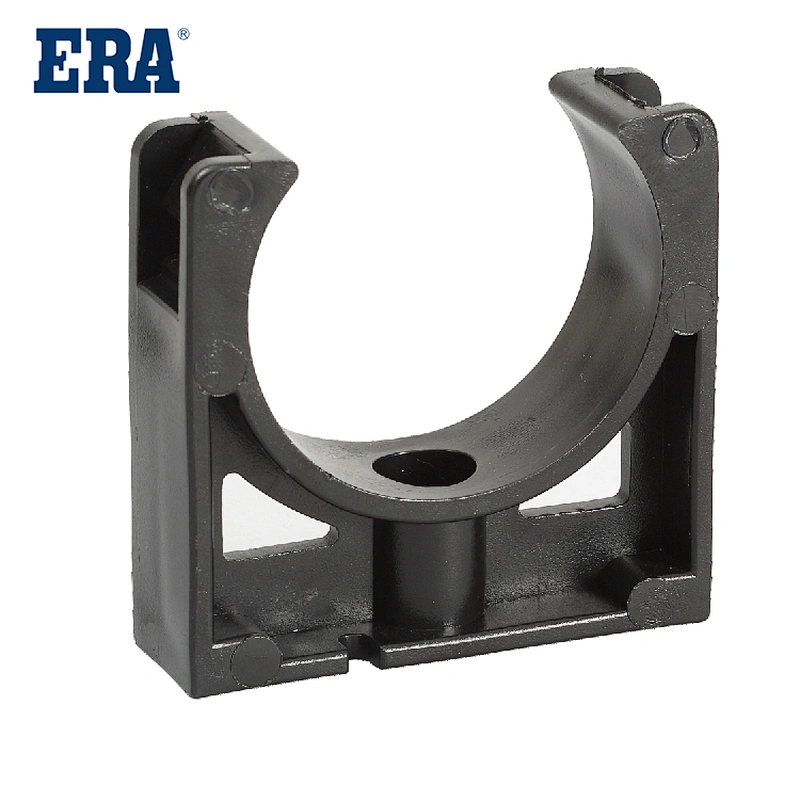
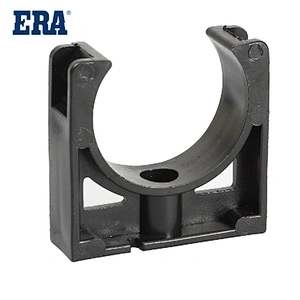
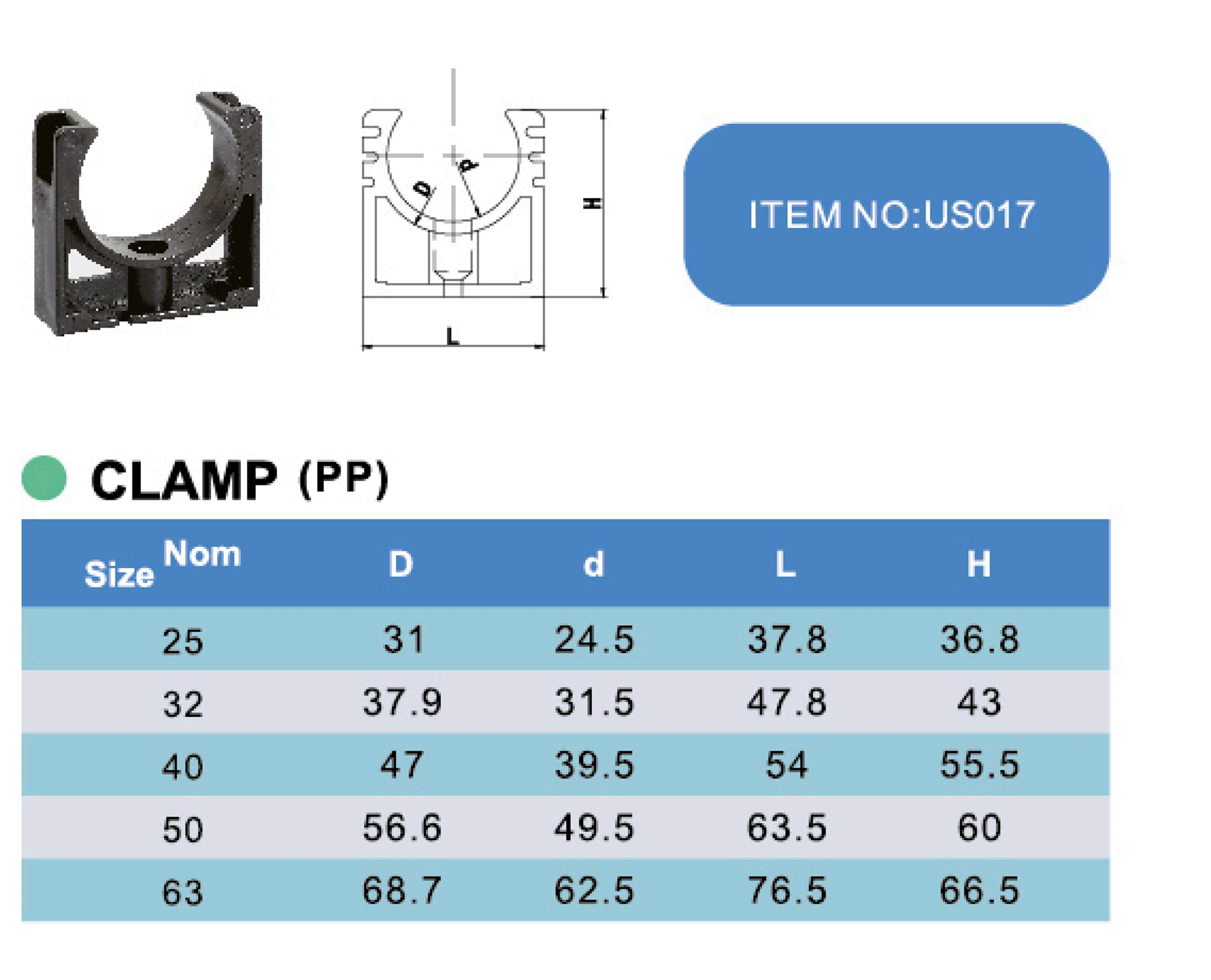
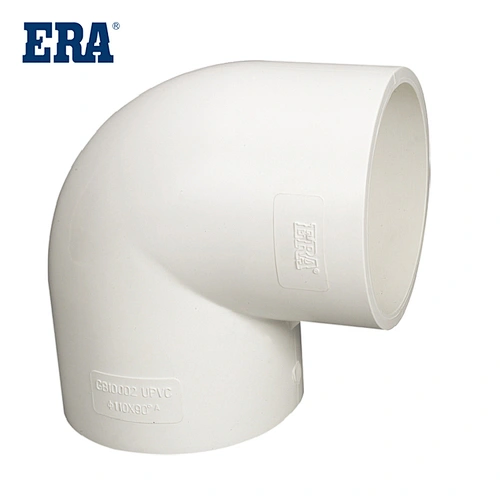
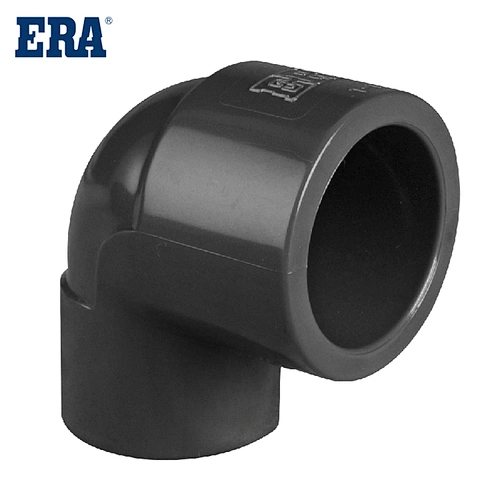
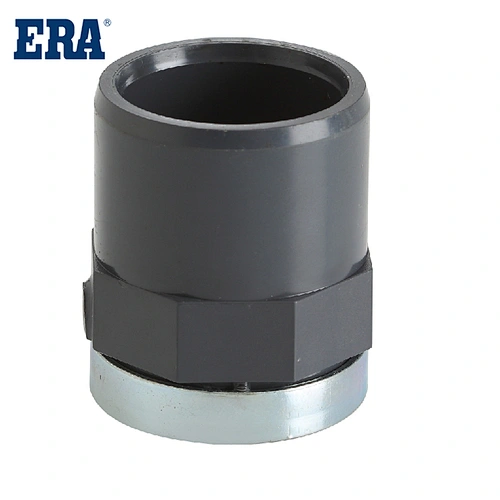
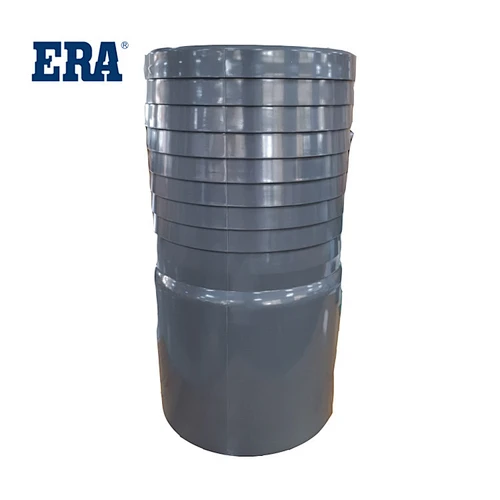
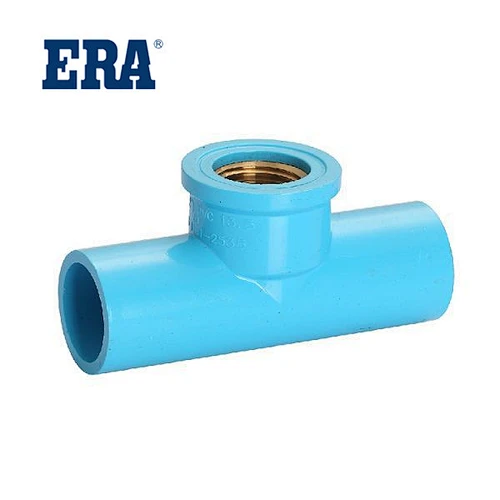
ERA pn10 fitting Piping Systems, pvc pipe fitting Pressure Pipe, Clamp(PP) , US017 , PN10 (ISO1452), plastic clamp,CE
Scope:
This series of fittings can match the standard ISO 1452.
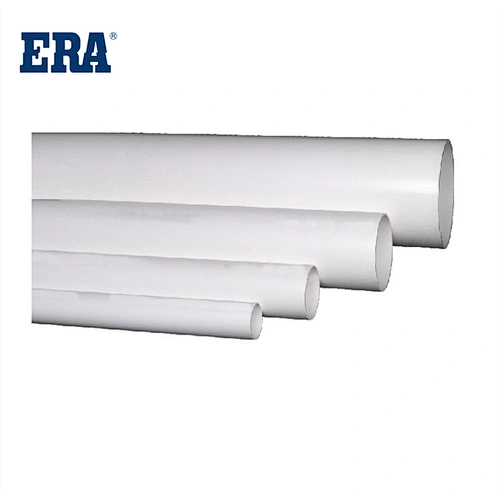
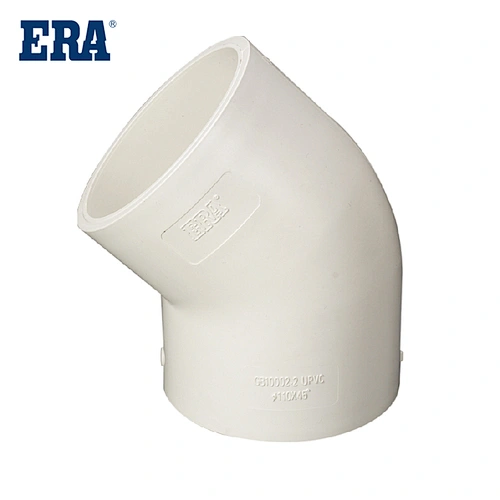
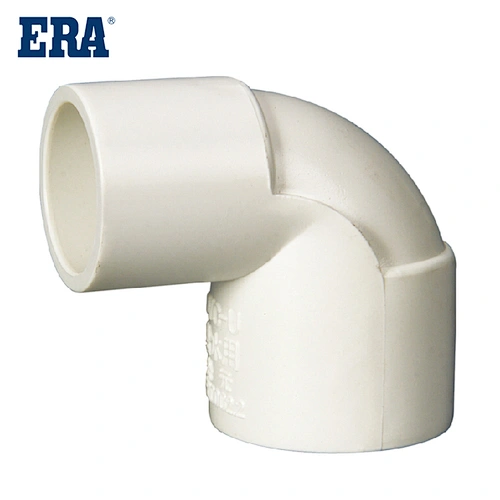
PVC-U MM sized fittings are available in sizes from 10mm to 500mm and in a choice of pressure ratings from 6 Bar to 16 bar. Manufactured in accordance with EN1452/2 and DIN 8063 all fittings are WRAS approved for use with potable water.
| Model Number | US017 | Material | PVC |
| Description | CLAMP (PP) | Standard | ISO1452 |
| Temperature | Max 60℃ /140℉ | Working Pressure | PN10 ,10Bar, 1.0Mpa |
| Size | 25-63MM | Certificate | DVGW |
| Connection | Socket | Color | WHITE BLACK GREY |
The dimensions of our fittings comply with ISO1452 standards, while many of our products meet other standards as well, including British, ASTM and Thai.
Pipe and fittings shall be manufactured from virgid PVC(polyvinyl chloride) vinyl compounds.
Sizes From D20 up to D400 Fittings threaded, solvent socket and adaptors
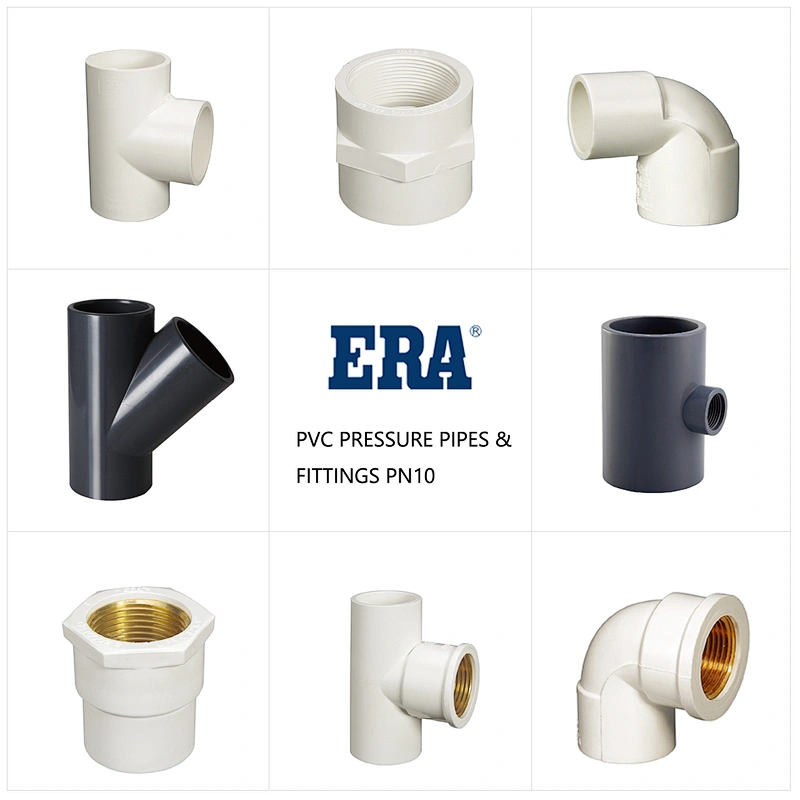
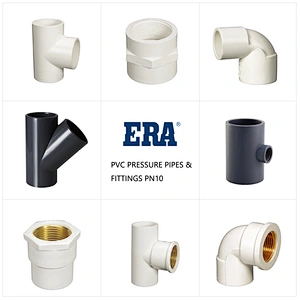
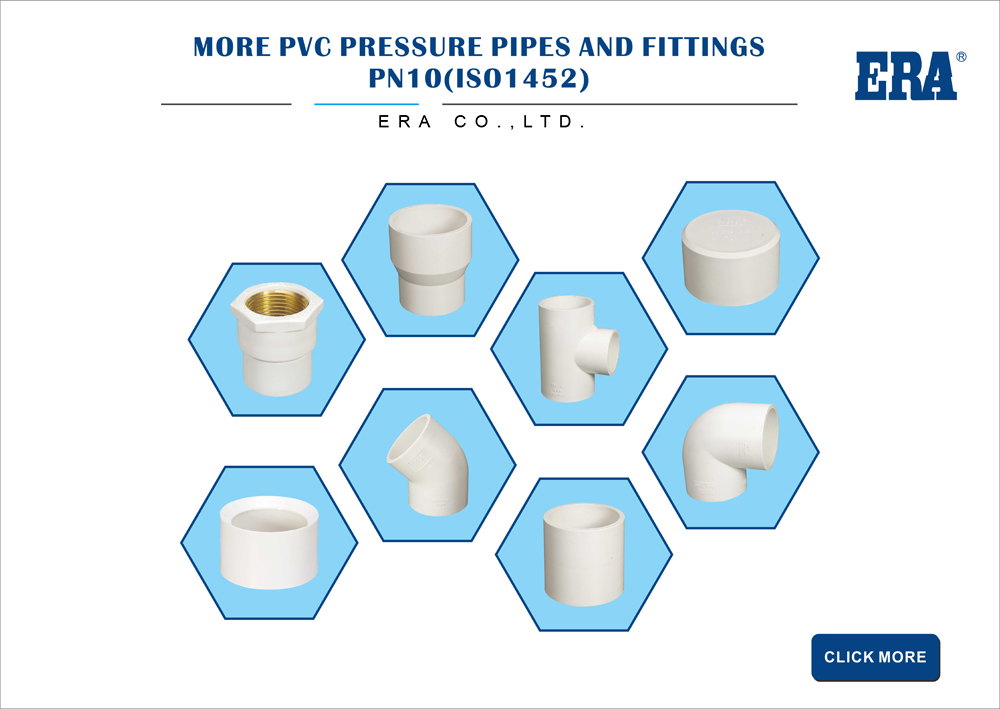
Main Products:
Features:
◇ Non-corrosive: PP pipes can withstand the corrosion of high-concentration acids and alkalis with a pH value ranging from 1 to 14 over a wide temperature range.
◇ Wear-resistant and non-scaling: The inner walls of PP pipes and fittings are uniform and smooth, with low flow resistance and no scaling.
◇ Reduce vibration and noise: PP pipe has excellent sound insulation properties and can significantly reduce vibration and noise caused by liquid flow.
◇ Anti-frost cracking: The excellent elasticity of PP material allows the cross-section of pipes and pipe fittings to expand with the frost-heaving liquid without cracking.
◇ Anti-condensation, less heat loss: PP material is a poor thermal conductor, which can reduce condensation and reduce heat loss.
◇ Simple installation: PP pipe is light in weight, easy to install and operate, and has weldability.
◇Long service life: The PP pipe system has a service life of 50 years under specified use conditions.
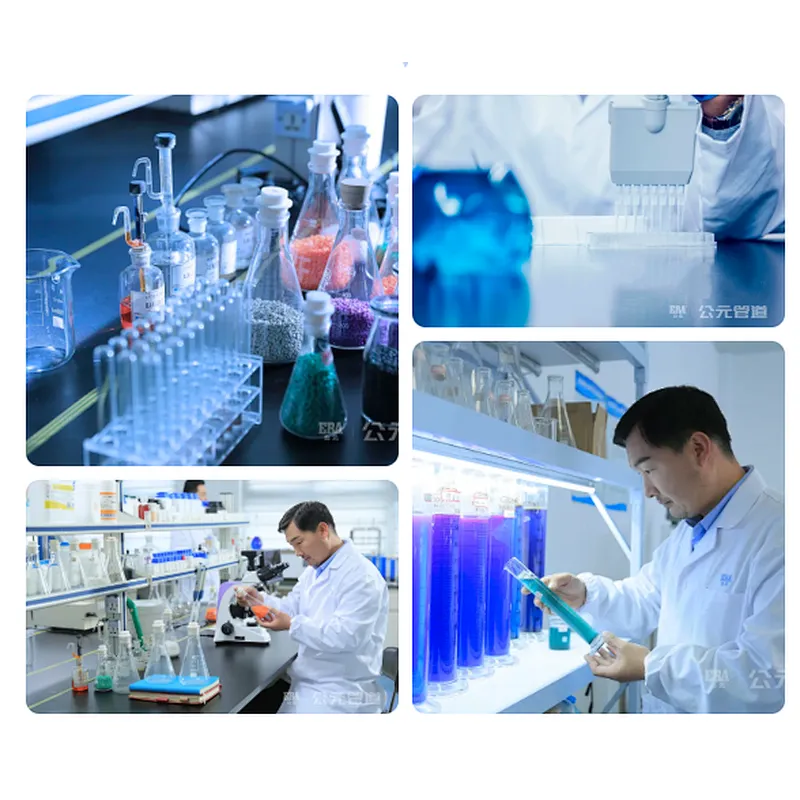
Suspension polymerization method: The monomer is suspended and dispersed in a droplet like manner in the aqueous phase, and the selected oil-soluble initiator is dissolved in the monomer. The polymerization reaction takes place in these droplets, and the heat of the polymerization reaction is promptly absorbed by the water. To ensure that these droplets are dispersed in a bead like manner in water, suspension stabilizers such as gelatin, polyvinyl alcohol, methyl cellulose, hydroxyethyl cellulose, etc. need to be added. Organic peroxides and azo compounds are commonly used as initiators, such as diisopropyl peroxydicarbonate, dicyclohexyl peroxydicarbonate, diethylhexyl peroxydicarbonate, azodiisoheptanitrile, azodiisobutyronitrile, etc. Polymerization is carried out in a polymerization kettle with a stirrer. After polymerization, the material flows into the monomer recovery tank or stripping tower to recover the monomers. Then it flows into the mixing kettle, washed with water, centrifuged for dehydration, and dried to obtain the finished resin product. Vinyl chloride monomer should be extracted from the resin as much as possible. The free monomer content of PVC used for food packaging should be controlled below 1ppm. To ensure the specified molecular weight and molecular weight distribution range of resin and prevent explosive polymerization during polymerization, it is necessary to control the temperature and pressure of the polymerization process. The particle size and distribution of the resin are controlled by the stirring speed and the selection and dosage of suspension stabilizers. The quality of resin is characterized by properties such as particle size and particle size distribution, molecular weight and molecular weight distribution, apparent density, porosity, fisheye, thermal stability, color, impurity content, and powder free fluidity. The polymerization reactor is the main equipment, made of stainless steel or enamel lining inside the steel reactor, equipped with an agitator and a heat transfer jacket for temperature control, or an internal cooling discharge pipe, reflux condenser, etc. In order to reduce production costs, the volume of the reaction kettle has gradually developed from a few cubic meters to more than ten cubic meters, reaching a maximum of 200 cubic meters (kettle reactor). The polymerization kettle needs to be descaled after multiple uses. PVC prepared with polyvinyl alcohol and cellulose ethers as suspension stabilizers is generally loose, porous, and has a large surface area, making it easy to absorb plasticizers and plasticizers.
Overview of PP pipes: (PP) Engineering grade polypropylene pipes are formed by extrusion of engineering grade polypropylene pellets.
This pipe is non-toxic, odorless, and widely used in fields such as chemical industry, environmental protection, food hygiene, and building water supply and drainage (in accordance with QB1929-93 standard).
Fiberglass reinforced polypropylene pipes are made of polypropylene pellets and fiberglass pellets, which are scientifically extruded into shape.
Can transport various turbid media below 120 ℃.
Its rigidity and compressive strength are superior to traditional plastic pipes, making it an ideal substitute for stainless steel pipes (following the HB20539-92 standard).
PP pipe features: non rusting: PP pipes can withstand high concentrations of acid and alkali corrosion within a large temperature range of pH values, ranging from 1 to 14.
Wear resistance and no scaling: The inner walls of PP pipes and fittings are uniform and smooth, with low flow resistance and no scaling.
Reducing vibration and noise: PP pipes have excellent sound insulation performance, which can significantly reduce vibration and noise caused by liquid flow.
Anti freezing and cracking: PP material has excellent elasticity, allowing the cross-section of pipes and fittings to expand with the frozen liquid without cracking.
Anti condensation and low heat loss: PP material is a poor thermal conductor, which can reduce condensation and minimize heat loss.
Easy installation: PP pipes are lightweight, easy to install, and have weldability.
Long service life: The PP pipe system has a lifespan of up to 50 years under specified usage conditions.
Long service life - PP pipes can be safely used for more than 50 years under rated temperature and pressure conditions.
Green mountains and clear waters are like mountains of gold and silver. After years of extensive development, China refuses to trade the environment for temporary economic growth.
The new plan for importing waste submitted by China to the World Trade Organization (WTO) in July last year was officially implemented on January 1st of this year. A total of 24 categories of waste, including domestic waste plastics, vanadium slag, unclassified waste paper, and waste textiles, have been prohibited from entering China. This is referred to by the media as a"ban on abolition".
After years of rectification actions against imported foreign waste, China has directly raised the standards for imported waste, which caught developed country waste distributors who have been exporting waste plastics, paper, and other materials to China off guard for a while. The domestic waste recycling industry has also been affected. But experts believe that this impact is temporary, and the improvement of standards is conducive to the survival of the fittest in the domestic waste recycling industry, achieving transformation and upgrading.
Strengthening supervision of solid waste imports
Many people born in the 1970s and 1980s may still remember the hit records and hit tapes that appeared in the early 1990s. These records and tapes are exported to China under the name of waste plastic.
Since the 1980s, in order to alleviate the shortage of raw materials, China has started importing solid waste that can be used as raw materials from overseas, which has played a certain role in filling the domestic resource shortage. Taking waste plastics as an example, due to the large domestic recycling market, the import volume increased by nearly 80% between 2005 and 2012. In 2012, the import volume of waste plastics was nearly 9 million tons, the peak in nearly 12 years.
But as the import volume continues to increase, problems are also emerging. At present, the construction of the domestic solid waste recycling system still lags behind the development needs of the solid waste processing and utilization industry. In addition, there is still a mindset of prioritizing development over environmental protection in some places, and some enterprises are willing to take risks to seek illegal benefits.
The person in charge of the Soil and Environmental Management Department of the Ministry of Environmental Protection introduced that in recent years, it has been found in environmental law enforcement inspections that many solid waste recycling and utilization enterprises are small in scale, have low pollution control levels, and have abnormal operation of pollution control facilities. Some places have neglected supervision of recycling and processing enterprises for renewable resources, and even allowed illegal processing and utilization of foreign waste. Many solid waste distribution centers have become hiding places for foreign waste, Environmental pollution is severe.
The action of rectifying the import of foreign garbage in our country began as early as 2013. In February 2013, Chinese customs launched a 10 month Green Fence Operation nationwide, targeting solid waste, including imported waste paper, hardware, plastic, etc., and severely cracking down on foreign garbage smuggling activities.
Although various regions and relevant departments have increased their efforts to crack down on the smuggling of foreign waste and have done a lot of work in strengthening the supervision of solid waste imports, the problem of illegal entry of foreign waste continues to persist, seriously endangering the physical health of the people and the ecological environment security of our country. The Chinese government has decided to strengthen the supervision of solid waste from the source.
Say"no"to high polluting garbage
Solid waste imported from abroad is often either unsorted or simply sorted, and heavy sorting work is transferred from abroad to China. Due to the underdeveloped technology of machine sorting and limited profit margins for solid waste recycling, the cost of using machines is often too high. Sorting is often done manually, posing a threat to the surrounding environment and the health of operators.
On the second day after submitting the memorandum to the WTO, the General Office of the State Council issued the Implementation Plan for Prohibiting the Entry of Foreign Garbage and Promoting the Reform of the Solid Waste Import Management System.
The implementation plan requires the improvement of the regulatory system for blocking the import of foreign garbage, and specifies that by the end of 2017, the import of waste plastics from domestic sources, unsorted waste paper, waste textile raw materials, vanadium slag and other solid waste with high environmental hazards and strong public feedback will be prohibited.
According to the implementation plan, China will gradually stop importing solid waste that can be replaced by domestic resources by the end of 2019; Adjust the management catalog of imported solid waste in batches and categories, gradually and orderly reducing the types and quantities of solid waste imports; Raise the import threshold for solid waste, further strengthen environmental protection control standards, and increase the scale requirements for imported waste paper processing and utilization enterprises; Improve laws, regulations, and relevant systems, limit the import ports for solid waste, and cancel the agency of trade units for imports.
The Ministry of Environmental Protection officially issued a notice on August 16, 2017 regarding the Catalogue of Imported Waste Management (2017). This announcement will come into effect on December 31, 2017.
The announcement points out that the Ministry of Environmental Protection, the Ministry of Commerce, the National Development and Reform Commission, the General Administration of Customs, and the General Administration of Quality Supervision, Inspection, and Quarantine have adjusted and revised the current"Catalogue of Prohibited Import Solid Waste","Catalogue of Restricted Import Solid Waste that can be used as Raw Materials", and"Catalogue of Non restricted Import Solid Waste that can be used as Raw Materials": 24 types of solid waste including waste plastics from domestic sources (8 varieties), unsorted waste paper (1 variety), waste textile raw materials (11 varieties), and vanadium slag (4 varieties) have been included in the"Catalogue of Prohibited Import Solid Waste".
At the same time as the release of standards, China has also increased the screening of existing solid waste importers. On November 16, 2017, the General Administration of Customs announced on its official website that it had recently completed a special inspection of all 1155 enterprises in the waste plastic industry that had obtained the Solid Waste Import License, and identified 236 problematic enterprises.
Irene, CEO of the UK Recycling Association, stated that the WTO held talks with China in December 2017, but did not change China's strong stance on banning the import of highly polluting waste.
The impact of new standards is evident
A ban has caused waves in countries that have been exporting solid waste to China for a long time.
In June 2017, the first Clean Energy Week conference held by the Financial Times revealed that the global plastic packaging recycling rate was only 14%. Currently, Europe can recycle 30% of its plastic, compared to only 9% in the United States. However, most waste plastics are still disposed of in landfills or discarded in the ocean.
A large amount of entangled garbage floats on the ocean. This type of marine debris is mostly in the form of particles, and even traces can be found 35 meters below sea level.
Plastic not only harms marine life, but also causes other problems, such as huge cleaning costs. Europe spends 600 million euros (approximately 4.7 billion yuan) annually on cleaning beaches and coastal areas, and the cost of cleaning has been increasing year by year.
Currently, global waste exports are highly dependent on China. According to the United Nations Commodity Trade Statistics Database (UNComtrade), over 36% of the world's waste paper was exported to China last year, while the Hong Kong Special Administrative Region of China received 70% of the world's plastic waste, with a total trade volume of $17 million and $4.6 million, respectively.
An environmental organization in the United States once conducted a survey: placing 200 trackers on discarded electronic products in the United States, it was found that most of them crossed the sea and arrived in Asia, of which 10 came to mainland China and 36 stayed in Hong Kong, China.
According to a report by the German newspaper, the South German newspaper, in 2016, Germany alone transported 1.5 million tons of waste plastics to mainland China and Hong Kong, accounting for half of Germany's total waste plastics. Last year, the UK transported nearly 800000 tons of plastic waste to China, accounting for approximately 65% of the total plastic waste in the UK.
A recycling station called"White City"in Oregon, USA, fell into chaos in early December. Due to the lack of Chinese buyers, 980 tons of recycled goods are stuck inside the station. Due to the fact that the station has been exporting recycled products to China, there is no corresponding recycling infrastructure. After the warehouse exploded, recycled goods were piled up outside the warehouse and piled up into mountains.
The Guardian reported that since 2012, the UK has exported 2.7 million tons of waste plastic to China, accounting for two-thirds of the UK's total plastic exports. The implementation of China's new waste import standards means that the UK needs to increase its waste treatment capacity by 350000 tons per year to fill the gap.
According to a report by The Paper, the UK waste disposal industry estimates that about half of the plastic waste currently exported from the UK to China for recycling will be affected due to non-compliance with China's new standards.
Although the increase in the threshold for importing solid waste has had an impact on the waste recycling industry, it is beneficial for the development of the entire industry in the long run. The report from Sinopec Economic and Technological Research Institute believes that the domestic recycled plastic industry will now face a re layout, either shifting to building factories in Southeast Asia, or shifting domestic business from processing imported waste plastics to processing imported plastic particles.
Due to the loss of most imported sources of recycled materials, waste plastic processors need to further tap into the potential of the domestic market, thereby promoting the development and standardization of the domestic waste plastic recycling industry. It is not difficult to predict that the recycled plastic industry will undergo a round of survival of the fittest, and enterprises with small production capacity and high pollution will be eliminated, thereby promoting industrial transformation and upgrading.
For the domestic synthetic resin market, in the short term, the decrease in the amount of imported waste plastics has freed up market space for raw materials of synthetic resin, leading to a rapid increase in demand; In the long run, after the upgrading of waste recycling enterprises, the amount of imported waste plastics may rise again, or directly import recycled material particles, which will compress the market space previously freed up for raw materials.
Meticulous - They rush to the machine
01 Careful inspection before startup
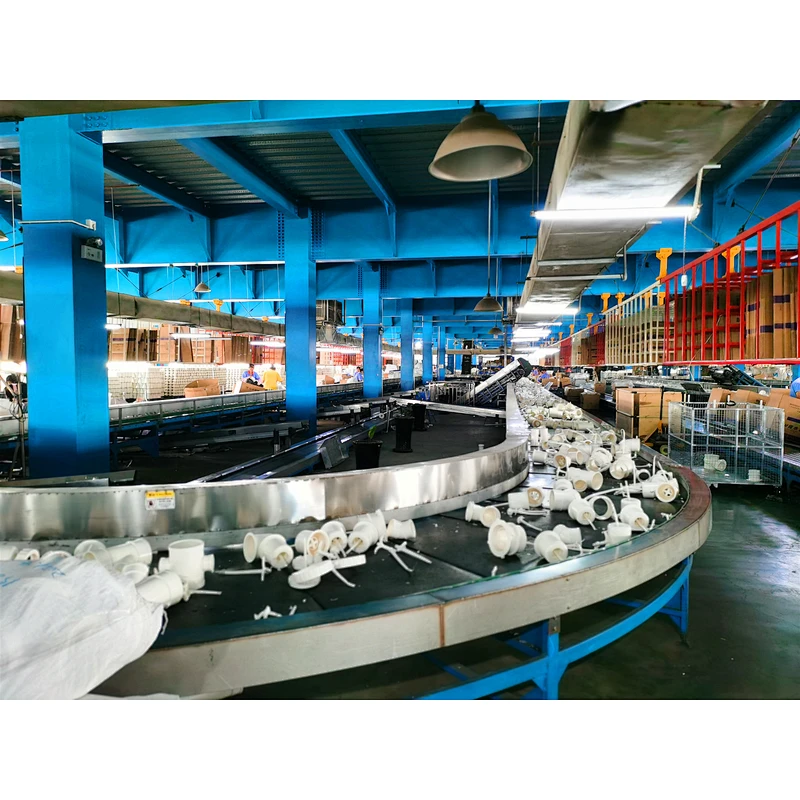
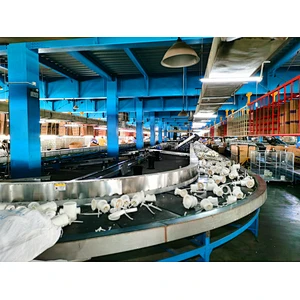
Before starting up, the workshop team leaders immediately carefully inspect every mold, every waterway, and every tool to ensure that there are no leaks or hidden dangers. If any abnormal situations occur on site, they should contact relevant personnel in a timely manner to handle them and ensure smooth startup.
02 Precautions during startup
During the startup process, in order to ensure that the team strictly follows the startup evaluation table, the judges distribute the evaluation table to each workshop in advance, so that the team leaders can confirm the progress of the implementation plan in a timely manner and ensure safe and smooth startup.
The process seems simple, but the actual operation is also quite cumbersome. Every production process cannot be separated from the intelligent crystallization of each member's improvement and optimization in the workshop. From meters to decimeters, and then to centimeters, every ultra precision parameter cannot tolerate any deviation, leave no defects, and ensure product quality.
During the entire startup process, the team members collaborated and cooperated with each other in a good atmosphere, achieving the best use of talents and resources. The personnel allocation and organization were convenient and reasonable, and the team strength was enhanced, effectively improving work efficiency and shortening maintenance time.
03 Final cleaning after startup
As the product is slowly processed and transported to the flipping frame, on-site operators carefully lift the product to the inspection table. The team leader conducted a self inspection first, and then the quality personnel conducted a comprehensive and careful inspection of the product. Every process, every execution, come and check!
On site cleaning is a very important part of 6S management. Each team actively carried out on-site 6S, and the workshop employees carried out a comprehensive and thorough cleaning of the workshop's machinery, floor, dead corners, etc. The workshop environment has become cleaner, and employees will also devote themselves to work with a brand new spirit and positive work attitude.
FAQ:
1.What is your MOQ?
Our MOQ is usually 5 CTNS.
2.What is your delievery time?
The time of delievery is around 30-45days.
3.What is the shipping port?
We ship the goods via Ningbo or Shanghai port.
4.What is your payment terms?
We accept 30% T/T in advance,70% in the period of shipment or 100% L/C.
5.How should I contact you?
You can contact us with Trade Manager or send us an email by click Contact Supplier bottom.
6.What is the location of your company?
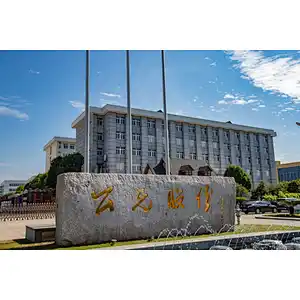
Our company is located in the Taizhou Zhejiang Province,China.
If you would like to have a visit, you are much welcome.
7.How about the samples?
We could send you the samples ,most samples are free to send to most places in China.If sent to other countries,transport fee shoule be paid by you.
8.Why choose us?
1 Genuine produces with excellent quality and competitive price.
2 Cooperating with the customers all over the world and knowing the markets very well.
3 ERA is a listed company. Everything can be rest assured working with us.
4 After- Services will be highly-satisfied. Any problems and feedbacks will be answered in a short of time.
Our Services:
1. Any inquiries will be replied within 24 hours
2. Professional manufacturer.
3. OEM is available.
4. High quality, standard designs, reasonable&competitive price, fast lead time.
5. Faster delivery: Sample will be prepared in 2-3days.
6. Shipping: We have strong cooperation with DHL, TNT, UPS, MSK, China Shipping, etc.
7. You can also choose your own shipping forwarder.


 English