1.Extended Service Life
HDPE pipe is a safe and durable product ideal for your piping infrastructure. The service life of HDPE is estimated to be between 50 to 100 years, depending on application, design and installation.
2.Trenchless Installation
Traditional piping systems are installed by open cut (digging a ditch), resulting in traffic and environmental disruption. HDPE can be installed using this traditional open-cut method or by utilizing eco-friendly trenchless technology.
For trenchless installation, a horizontal directional machine bores a continuous hole beneath the ground. When the drilling head reaches the end of the bore, the pipe is attached and pulled back through the hole.
The flexibility of HDPE, combined with its outstanding tensile strength and abrasion resistance, make it the preferred and proven choice for trenchless installation technology
Advantages:
1, hdpe raw materials are mostly powder, color is milky white, if the raw material is granular, then the surface will appear translucent, this need not be too worried, because the material itself is very good water absorption performance, and is not easy to dissolve, so it is widely used in the industrial industry.
2. hdpe material has high density, good pressure resistance, strong mechanical properties, and all properties are excellent, including wear resistance, moon circle and toughness, etc., which is a very excellent polymer material. In addition, hdpe material not only has excellent high temperature resistance, even in the cold environment, but also can be very good to use.
3. The performance of hdpe material is excellent, but it has a fatal disadvantage, that is, the aging resistance is general. If the effect of thermal oxidation is experienced for a long time, the performance of the product will be rapidly reduced, thus shortening the service life of the material. If manufacturers want to overcome this situation, they must add a lot of antioxidants, which can affect the environmental performance of the material.
The so-called"HDPE hollow wall winding pipe"refers to HDPE winding structure wall - A-type pipe (note: the carat pipe we often refer to belongs to B-type pipe). We have previously introduced the difference between A-type pipe and B-type pipe. Here, we will separately introduce A-type pipe. 1、 What is HDPE hollow wall winding pipe? HDPE hollow wall winding pipes are made of high-density polyethylene raw materials, and rectangular pipe blanks are extruded through efficient and high compression ratio single screw extruders. Through a special hot state winding forming process, special hollow"I"- shaped and double flat wall structure pipes are formed, which have excellent ring stiffness and good strength and toughness. 2、 What is the production process of hollow wall wrapped pipes? HDPE hollow wall winding pipes are first extruded into square tube blanks in the process, then shaped after water cooling, and then wound into circular tubes, which are then cooled with water. What are the characteristics of hollow wall wrapped pipes? (1) Large diameter: The production process of hollow wall wrapped pipes is not limited by the diameter of the pipe. Its unique molding process can produce large-diameter pipes up to DN3000, which is difficult to achieve with other production processes; (2) Unique structure: a special hollow"I-shaped"structure with large elastic deformation and resistance to damage, which has good applicability to any base; (3) Corrosion resistance: not corroded by sewage, wastewater, and chemicals, not corroded by decaying substances in the soil; (4) Lightweight: Due to the hollow structure of the pipe material, while maintaining rigidity, it saves raw materials, facilitates construction, does not require large installation equipment, reduces labor intensity, and shortens the construction period; (5) Strong impact resistance: Hollow wall wrapped pipes have smooth inner and outer surfaces and belong to flexible pipes. It has good extensibility, strong resistance to pressure and uneven settlement, and improves the seismic and disaster reduction capabilities of public facilities. (6) Wide applicability: Construction is subject to low requirements due to seasonal and temperature constraints, and can operate normally within a temperature range of -40-60 ℃ without freezing, cracking, expansion, or leakage. 3、 What is the connection method for hollow wall wrapped pipes (1) White steel clamp type connection: The white steel clamp type elastic connection integrates rigid and flexible connections, with the inner layer sealed and the outer layer using stainless steel clamps to increase the strength of the interface. (2) Heat shrink sleeve connection: The principle of heat shrink tape connection is to align the two ends of two pipes placed flat on the same axis (remove moisture, mud, and other debris from the connection ends), preheat them, wrap them with heat shrink tape, and then bake them with a spray gun to fuse with the pipes. (3) Sealing ring socket connection: The principle of sealing ring socket connection is to fit the sealing rubber ring on a smaller section of the pipe diameter, and then connect the small and large heads through socket connection (this method is the fastest, most time-saving and labor-saving way). 4、 What are the execution standards for hollow wall wrapped pipes—— Execution standard: GB/T 19472.2-2017"Polyethylene (PE) Structural Wall Pipeline Systems for Underground Use"Part 2:"Polyethylene Wrapped Structural Wall Pipes"- Download link: https://pan.baidu.com/s/1dBnvIDQpcO0A448pVAN-vg (Extraction code: gdbz) Five: What are the application areas of hollow wall winding pipes? HDPE hollow wall wrapped pipes are used for transporting municipal drainage, outdoor building drainage, buried farmland drainage, industrial sewage, road drainage, sewage treatment plants, sports field square engineering drainage, and electrical and telecommunications engineering with water temperatures below 45 ℃.
Double flat wall pipe, full name"HDPE double flat wall steel plastic composite winding drainage pipe", is this the product: does it have a familiar feeling? The appearance is almost identical to that of a hollow wall wrapped tube, with the difference being that the double flat wall tube is"steel plastic composite", while the hollow wall tube is"all plastic". Now let's introduce in detail: 1. What is a double flat wall tube? HDPE double flat wall steel plastic composite winding drainage pipe (referred to as"double flat wall pipe") is a third-generation new steel plastic drainage pipe made of polyethylene (PE) as the main raw material, prefabricated into a"T"- shaped plate strip. The plate strip is wrapped and welded into a pipeline on a pipe forming machine. At the same time, a W-shaped steel strip rolled from galvanized steel strip is embedded in the groove between the two plate strips, and PE is wrapped on the steel strip to form the outer wall of the pipeline. 2、 What are the characteristics of double walled pipes? (1) Safe and non-toxic: The plastic material used for the pipes is polyethylene resin that can meet the hygiene level of drinking water. It is suitable for large-diameter long-distance gravity self-cleaning water supply pipelines and will not cause secondary pollution to the conveying medium; (2) Strong conveying capacity: Under the same caliber and usage conditions, the conveying capacity of double flat wall pipes is 30% higher than that of cement pipes; (3) Long service life: Under normal use, the service life of double wall pipes can reach 50-100 years, which is much higher than the service life of cement pipes or metal drainage pipes; (4) Low overall project cost: For large-diameter pipelines, considering manufacturing costs, transportation and installation savings, the comprehensive cost of double wall pipeline projects is lower than other types of pipelines except for cement pipes; (5) No leakage: The structure is advanced, the joints between the plates and strips are uniform and firm, and the pipeline section is also well sealed; (6) The pipeline wall thickness is uniform and consistent, and the performance is consistent: due to the uniform and consistent thickness of the pipe wall (non corrugated), there are no weak links, and the pipe wall performance is uniform and consistent. (7) Pipeline adaptation to non excavation construction: Due to the double wall structure of the pipe wall, the actual tensile strength of the pipe wall fusion joint is twice the inspection value, with a balance of rigidity and flexibility. After extremely rigorous destructive experiments, it has been proven that HDPE double flat wall steel plastic composite drainage pipes can withstand harsh environments, resist ground settlement, and adapt to non excavation construction. 3、 What is the connection method for double wall pipes? (1) Heat shrink sleeve connection: The contact surface is relatively wide, the water resistance is good, the connection is reliable, the cost is low, and the operation is convenient. (2) Rubber ring socket connection: Add a flared connector at the cut end of the pipeline to form a bell mouth. Add a rubber ring on the surface of the pipe end and insert it into the bell mouth. The advantage is that it can work in the presence of water in the pipe trench. (3) Stainless steel clamp connection:
The advantage is that there is a layer of steel on the surface as support, ensuring the compressive strength of the pipeline joints; (4) Electric fusion connection: Use electric fusion tape to perform electric fusion connection at the connection between pipelines. 4、 What are the specifications and dimensions of double wall pipes? According to the urban and rural construction standard CJ/T 329-2010 for buried double flat wall steel plastic composite wrapped drainage pipes, the ring stiffness is mainly divided into three levels: SN8, SN12.5, and SN16, with specifications ranging from DN300 to DN3000, as shown in the following figure: IV. Application fields of double flat wall pipes—— Water conservancy engineering: used as a water source pipe and irrigation pipe—— Municipal engineering: used as buried rainwater and sewage pipes—— Construction projects: rainwater pipes, underground sewage pipes, ventilation pipes, etc. in cities such as apartments and residential gardens—— Communication engineering: used as communication cables and optical cable protection pipes—— Industrial application: widely used in the industrial field for sewage and drainage pipes—— Agricultural engineering: used for irrigation, farmland, orchards, tea gardens, and forest belt drainage and irrigation (farmland consolidation)—— Road engineering: used as infiltration and drainage pipes for railways and highways—— Mine engineering: used for mine ventilation, air supply, drainage, and mud tanks—— Sports venues: used as infiltration and drainage pipes for golf courses, football fields, squares, etc—— Dock airport: used as rainwater drainage pipes for large ports, docks, and airport projects—— Environmental protection field: landfill sewage collection pipes, manure and urine treatment plants—— Water storage system: a water storage system used to intercept slow water flow—— 5. Implementation standards and download connections for seawater transportation pipelines, bridge and culvert pipelines, etc. - Implementation standard: CJ/T 329-2010 Buried Double Flat Wall Steel Plastic Composite Wrapped Drainage Pipe.
The most common HDPE double wall corrugated pipe on the market has a black inner wall color. However, in practical applications, various HDPE double wall corrugated pipes with different inner wall colors such as blue, yellow, even green, red, etc. can also be encountered. You can refer to the following figure: The inner wall colors of HDPE double wall corrugated pipes are so many that only you can't think of them, and no factory can do it. The widely circulated online statement about the relationship between inner wall color and quality is that HDPE double wall corrugated pipes with black exterior and black interior are national standards, while HDPE double wall corrugated pipes with black exterior and blue interior are non-standard. However, this statement is not accurate. According to the national standard GBT19472.1-2019 for HDPE double wall corrugated pipes, the regulations on pipe color are as follows: the color of the inner and outer layers of the pipe should be uniform and consistent, and the outer layer is generally black. Other colors can be agreed upon by the supply and demand parties. Therefore, the color of the inner wall of the pipeline is not used to distinguish between national and non-standard standards, nor is it used to distinguish different purposes. The reason for the appearance of various colored inner walls is the same as the color of HDPE solid wall pipes, which is due to the addition of different colored colorants during the production process. Masterbatch is a high concentration pigment or coloring agent, usually in the form of particles or powders, which can be mixed with polyethylene resin to achieve coloring purposes. In the final analysis, regardless of the color of the inner wall of the HDPE double wall corrugated pipe, the factors that measure its performance are still core indicators such as ring stiffness, ring flexibility, and impact performance. As for the color of the inner wall, it is not directly related to the quality of the pipeline and can be agreed upon by both the supply and demand sides according to their needs.
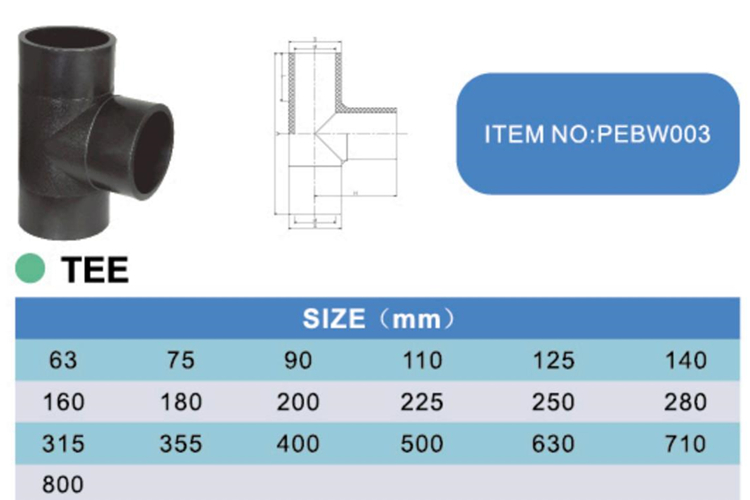
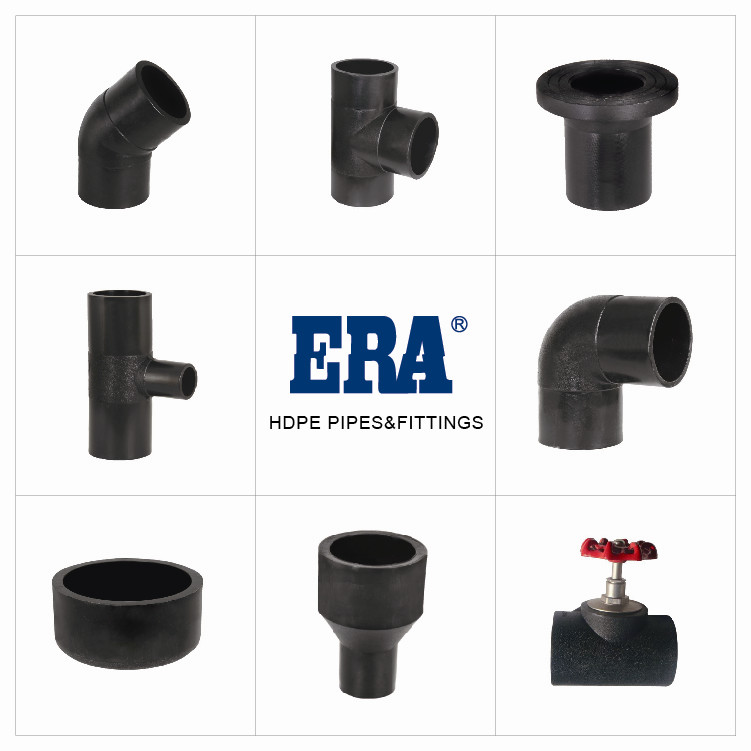
PE fittings are mainly divided into three types: PE hot melt socket fittings, PE hot melt butt fittings, and PE electric melt socket fittings. The specific introduction is as follows: 1. PE hot melt socket fittings. The inner diameter of PE socket fittings is equal to the outer diameter of the pipe, and socket fittings are connected by a hot melt machine
—— Applicable specifications: It is mostly suitable for small-diameter pipelines with an outer diameter of 63 or less, and the maximum specification is for pipelines with an outer diameter of 110
—— Connection characteristics: Socket connection is mainly due to the thin wall of small-sized pipe fittings, which are not suitable for hot melt butt connection. When welding pipe fittings and pipes, one end of the pipe is inserted into the fusion joint of the pipe fitting and then welded together. 2、 PE hot melt butt fittings have the same diameter as the pipe, and are connected using a hot melt butt welding machine
—— Applicable specifications: It is mostly suitable for large-sized pipelines with an outer diameter of 110 or more, and can be used for pipelines with a minimum outer diameter of 63—— Connection characteristics: Hot melt connection has high strength and good sealing, but the welding speed is slow and cannot be welded in narrow environments; 3、 PE electric fusion socket fittings The inner diameter of PE electric fusion fittings is the outer diameter of the pipe. When connecting, the pipe should be inserted into the fitting and then welded using an electric fusion welding machine
—— Scope of application: Mainly used for HDPE steel wire mesh skeleton composite pipes and HDPE solid wall water supply and drainage pipes
—— Characteristics of fittings: Electric fusion fittings have good reliability and high efficiency in connection, and are less affected by external environment and human factors during construction. However, compared to hot melt welding, electric fusion welding requires additional fittings, which is generally considered to be more expensive;
The above are the three classifications of PE pipe fittings. To summarize, for small-diameter pipelines, hot-melt socket fittings are selected, while for large-diameter pipelines, electric melt socket fittings and hot-melt butt fittings are selected. As for how to choose electric melt socket fittings and hot-melt butt fittings, multiple factors such as construction environment, cost, and construction period should be comprehensively considered.
In my work, I often encounter clients who need to inspect PE water supply pipes, but I am not very clear about which specific items to inspect. Here is a summary of the inspection items for PE water supply pipes for your reference. However, the focus may vary for each engineering project, so it is necessary to analyze each project specifically. Firstly, the standard environment for the state adjustment and testing of PE water supply pipe samples is determined according to GB/T 2918, with a temperature of 23 ℃± 2 ℃ and a state adjustment time of 24 hours. If there are provisions in the test method standards, follow the test method standards; Observe with the naked eye whether the color and appearance meet the national standard requirements.
Other related testing items are as follows:
(1) Pipe length: Measure the straight pipe with a steel tape measure accurate to 1mm;
(2) Average outer diameter: Measure the average outer diameter according to GB/T 8806 regulations;
(3) Wall thickness and deviation: Measure the wall thickness and deviation of the pipe according to GB/T 8806 regulations;
(4) Carbon black content: according to the provisions of GB/T 13021-1991;
(5) Pigments and carbon black dispersion: carried out according to GB/T 18251-2019, using the method of pressing samples;
(6) Oxidation induction time: According to GB/T 19466.6-2009, when preparing the sample, the sample should be cut from the inner and outer surfaces of the pipe, and then the original surface should be tested with it facing up.
(7) Melt flow rate: according to GB/T 3682.1;
(8) Static hydraulic strength: According to GB/T 6111-2018, the medium inside and outside the pipe is water (water water medium), and A-type joints are used;
(9) Elongation at break: According to the GB/T 8804-2003 standard, the testing method for the elongation at break of pipes with a wall thickness of less than or equal to 12mm and a wall thickness greater than 12mm is specified, which means that all wall thicknesses can be measured. Note: This section includes the test methods for tensile properties of polyolefin (polyethylene, cross-linked polyethylene, polypropylene, and polybutylene) thermoplastic pipes
(10) Longitudinal shrinkage rate: According to GB/T 6671-2001, three samples are taken from one pipe. For pipes with an outer diameter greater than 200mm, four pieces can be uniformly cut along the axial direction for testing;
(11) Hygiene requirements: carried out in accordance with GB/T17219 regulations;
A type of polyethylene pipe that can withstand high temperatures - PE-X pipe, also known as cross-linked polyethylene pipe. Here, PE-RT pipe is the second type of polyethylene pipe that we introduce that can withstand high temperatures. Let's introduce it in detail below. 1、 What is PE-RT pipe? PE-RT stands for Polyethylene of raised temperature resistance, which is a thermally enhanced pipeline made by the copolymerization of ethylene and octene monomers through metallocene catalysis. Its full name is"high-temperature heat-resistant polyethylene pipe", and it has good heat resistance, impact resistance, creep resistance, and welding performance. 2、 What are the characteristics of PE-RT pipes? (1) Heat resistance: The long-term use temperature of PE-RT pipes can reach 95 ℃, and the short-term use temperature can reach 110 ℃, with significantly better heat resistance than ordinary PE pipes; (3) Impact resistance: PE-RT pipes have a low temperature brittle fracture temperature of -70 ℃, and have high impact resistance under low temperature conditions. They are not easily damaged during winter construction; (4) Creep resistance: PE-RT pipes have better creep resistance than ordinary PE pipes and have a longer service life;
(5) Welding performance: PE-RT pipes have good hot melt connection performance, stable and reliable connection quality, and are not prone to leakage; (4) Lightweight and easy to install: PE-RT pipes are lightweight, easy to carry and construct, and greatly improve installation efficiency compared to traditional metal pipes. 3、 Classification of PE-RT pipes? PE-RT pipes are divided into PE-RT I type pipes and PE-RT II type pipes according to the different raw materials. (1) PE-RT type I pipe: made by polymerizing low-density polyethylene (LDPE) or medium density polyethylene (MDPE) with copolymer monomer octene, generally suitable for floor radiant heating systems below 60 ℃; (2) PE-RT II type pipe:
Made by polymerizing high-density polyethylene (HDPE) with copolymer monomers ethylene or butene, it has stronger thermal stability and compressive strength, and can be used at temperatures up to 70-90 ℃. Mainly used for industrial and civil building cold and hot water pipeline systems, drinking water systems, thermal pre embedded pipes, ground radiation heating systems, and high-temperature ground source heat pump systems, especially in the secondary pipeline network of urban heating systems in the north. 4、 What is the color of PE-RT pipe? The underfloor heating pipes are generally in their natural color, while the pipes for drinking water, hot spring pipelines, and central heating secondary pipelines are generally gray. Other colors can be determined through negotiation between the supply and demand parties. 5、 Execution standards and download links—— Execution standard: GB/T 28799.1-2020
https://www.instagram.com/era.yonggao/


 English