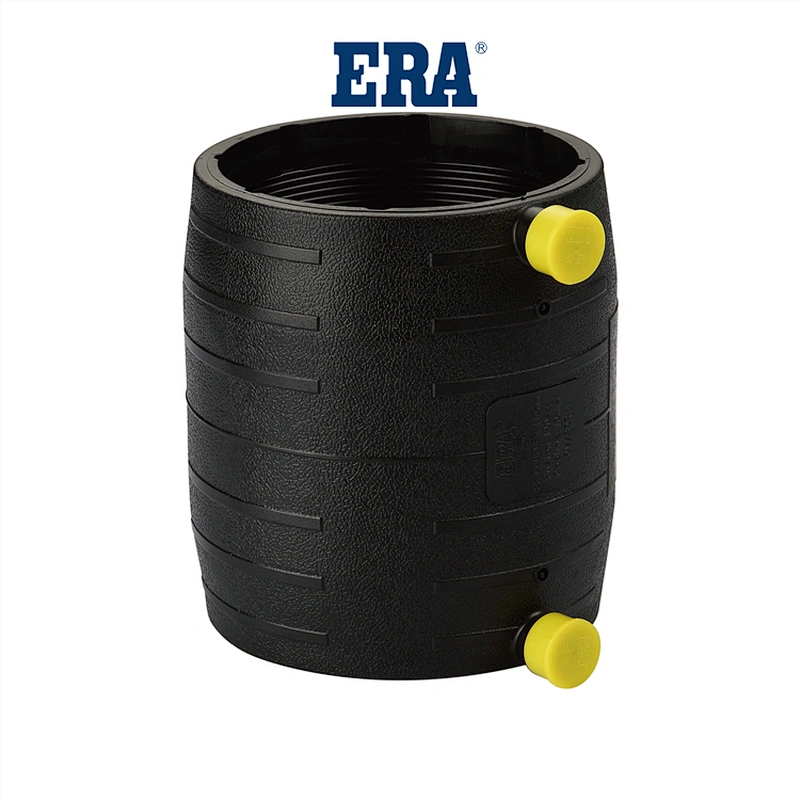
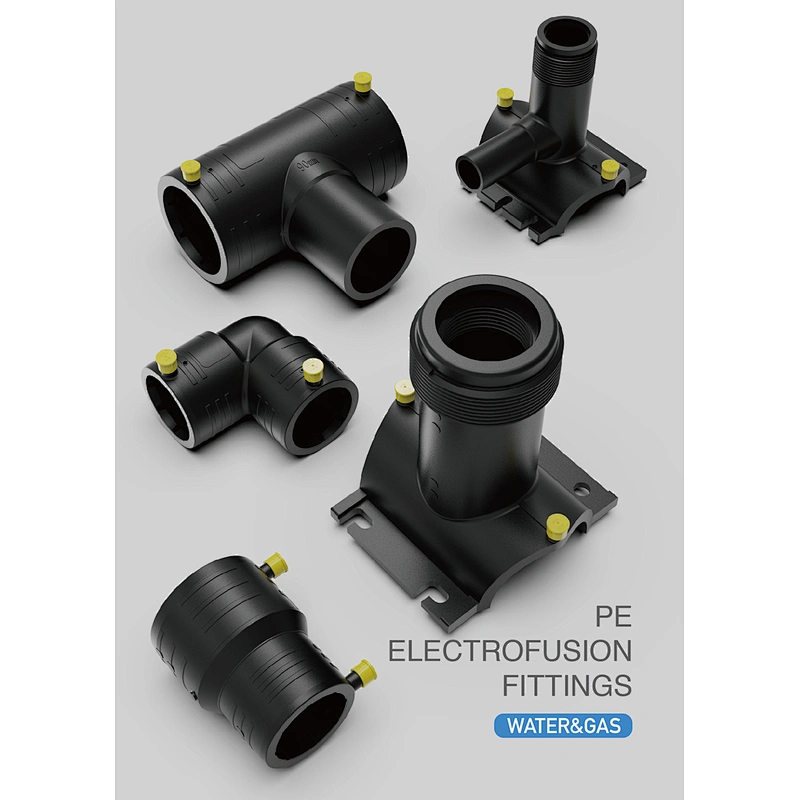
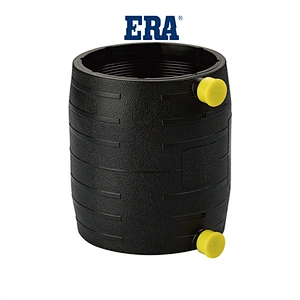
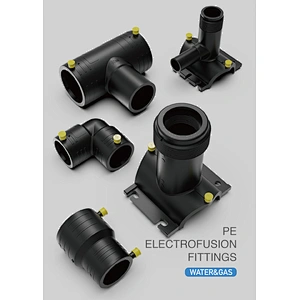
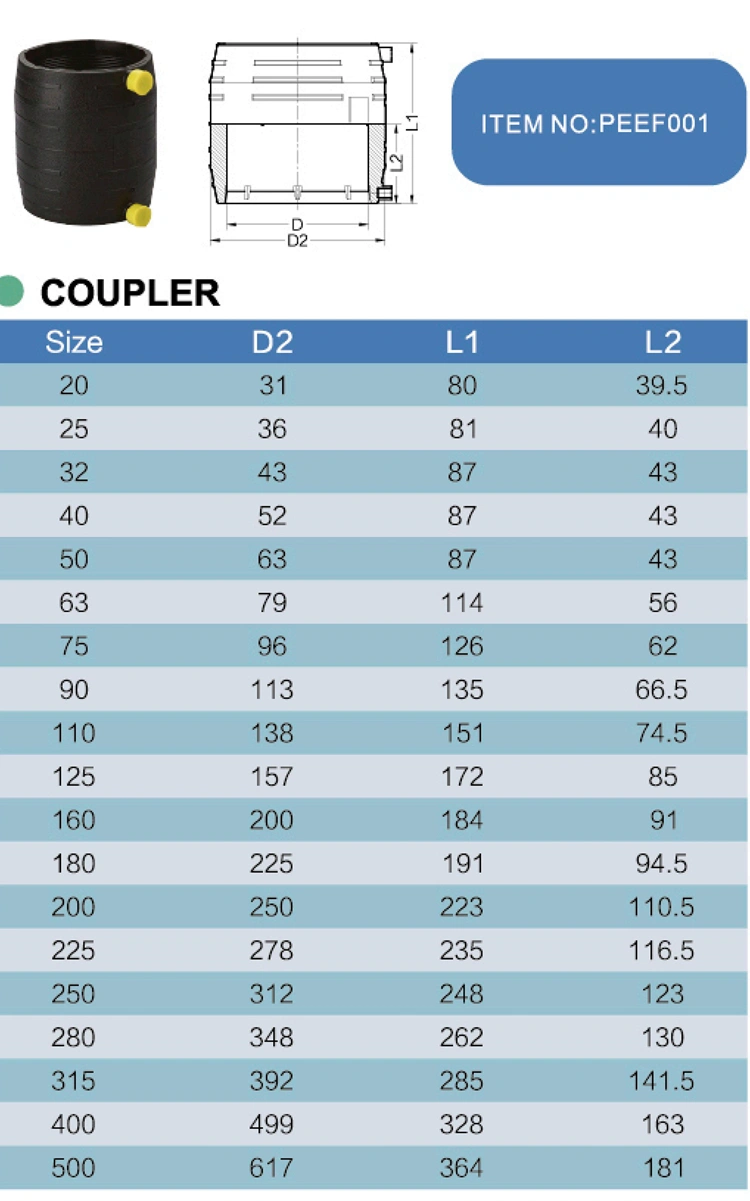
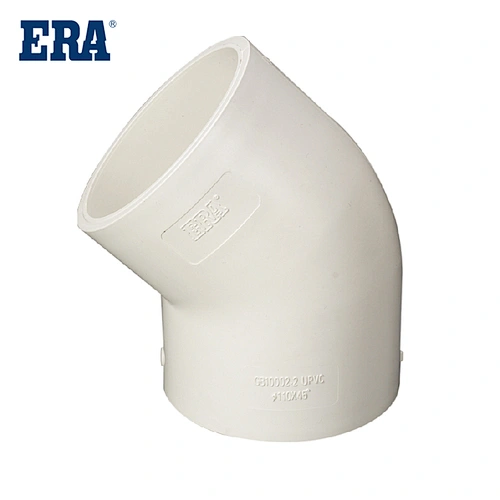
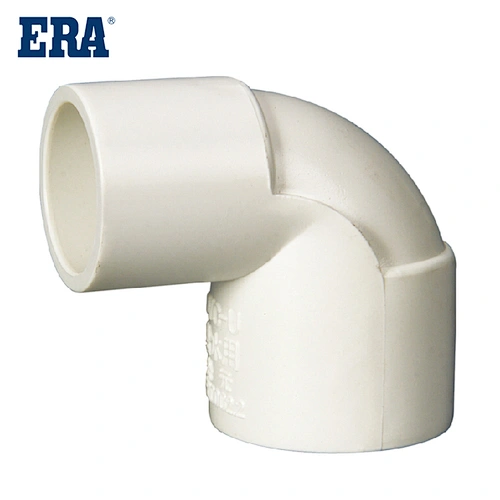
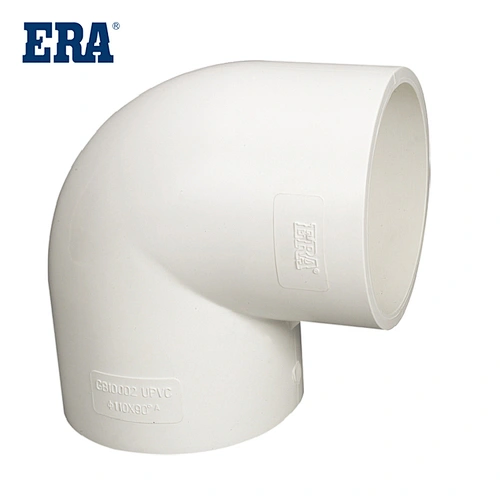
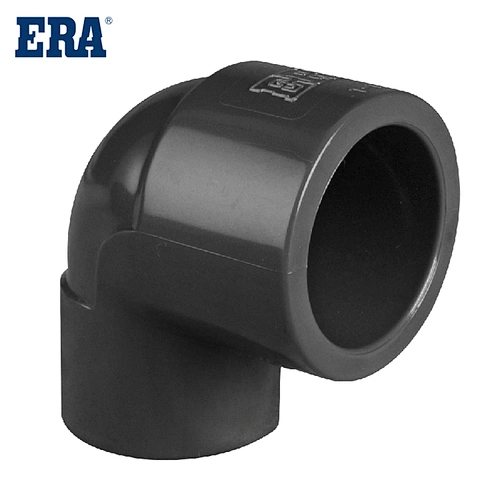
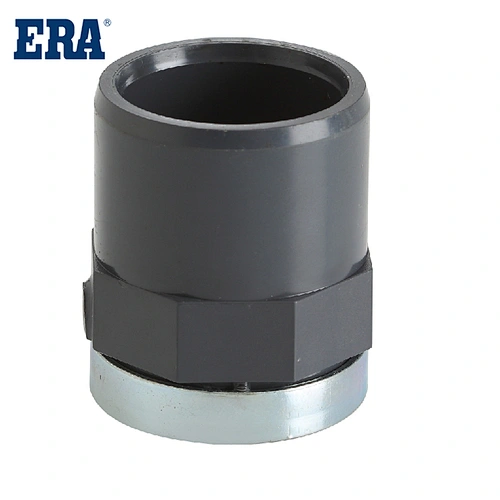
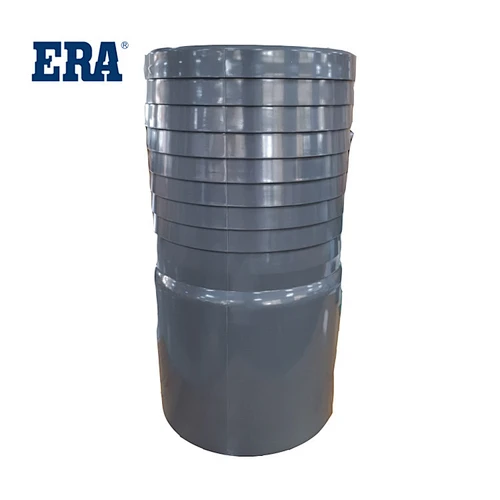
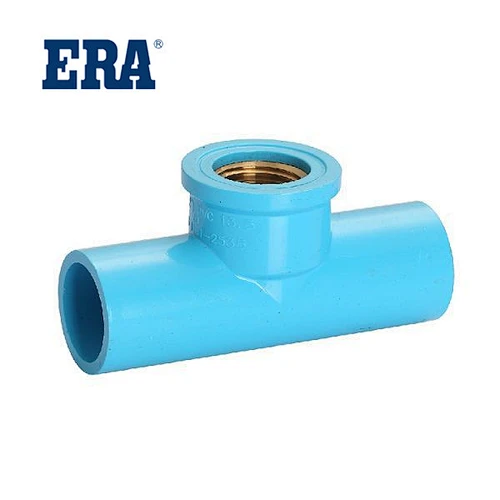
ERA Brand PE Electrofusion Fittings For Gas and Water Coupler,plastic conncetor,plumbing fittings socket
System:PVC pipe system
Scope:HDPE pipe system is used across the globe for applications such as water mains, gas mains, sewer mains, slurry transfer lines, rural irrigation, fire system supply lines, electrical and communications conduit, and stormwater and drainage pipes.
Referenced Standards:DIN STANDARD
Specification:
Mode Number | PEEF001 | Material | PE |
Description: | pipe coupling | Color: | black |
Size: | 20--500mm | Certificate: | CE |
High-density polyethylene (HDPE) or polyethylene high-density (PEHD) is a polyethylene thermoplastic made from petroleum.
HDPE is known for its large strength to density ratio. The density of HDPE can range from 930 to 970 kg/m3. Although the density of HDPE is only marginally higher than that of low-density polyethylene, HDPE has little branching, giving it stronger intermolecular forces and tensile strength than LDPE. The difference in strength exceeds the difference in density, giving HDPE a higher specific strength. It is also harder and more opaque and can withstand somewhat higher temperatures (120°C/ 248 °F for short periods). High-density polyethylene, unlike polypropylene, cannot withstand normally required autoclaving conditions. The lack of branching is ensured by an appropriate choice of catalyst (e.g., Ziegler-Natta catalysts) and reaction conditions
High density polyethylene, or HDPE, is a fashionable thermoplastic material made from petroleum. HDPE is known for its excellent tensile strength, high melting point, low cost and good impact strength. HDPE can be used in a variety of applications such as milk cans, plastic bottles, beach bottles, cutting boards and pipes due to its impressive performance.
HDPE is also very easy to manufacture and weld with any standard thermoplastic welding equipment, primarily available in sheet and bar form.
The easy soldering properties and versatility make the HDPE the right choice for manufacturing large plastic products, such as water tanks and chemical tanks, that are difficult to manufacture without the use of advanced plastic materials.
HDPE is also available in a variety of additional grades. It can be used to manufacture a variety of products in many categories, such as FDA-compliant cutting boards, disinfectants for medical facilities, wood grain textures for outdoor environments, and more.
PE electrical conduit is a product made of PE (modified polyethylene) that undergoes hot dipping plastic or epoxy resin coating inside and outside, which has excellent corrosion resistance. At the same time, the coating itself also has good electrical insulation properties, and will not produce electric discharge. It has low water absorption rate, high mechanical strength, small friction coefficient, and can achieve the purpose of long-term use. It can also effectively prevent damage caused by plant roots and soil environmental stress.
PE electrical conduits are widely used in fields such as power threading, communication threading, and building threading. Its advantages include:
1. High corrosion resistance: PE electrical conduits can resist the corrosion of various acids, alkalis, salts, and organic solvents, and are suitable for various harsh environments.
2. Good electrical insulation performance: The coating of PE electrical conduits has good electrical insulation performance, which can effectively prevent the occurrence of electric discharge.
3. High impact resistance: PE electrical conduits have high impact resistance and can withstand large external force impacts.
4. Good wear resistance: PE electrical conduits have a small friction coefficient and excellent wear resistance, with a long service life.
5. Good weathering resistance: PE electrical conduits have good weathering resistance and can be used outdoors for a long time.
6. Easy to install: PE electrical conduits are lightweight and easy to handle and install, with high construction efficiency.
7. Energy saving and environmental protection: PE electrical conduits are made of environmentally friendly materials and meet the requirements of national environmental protection policies.
8. Low maintenance cost: PE electrical conduits have a long service life and low maintenance cost, reducing the operating cost.
Although PE electrical conduits have many advantages, there are also some disadvantages. Firstly, the pressure resistance of PE electrical conduits is relatively low, so it is mainly suitable for low pressure and small diameter occasions, such as being made into coiled pipes for rural water reform and some non-long-term use occasions. Secondly, PE electrical conduits are easy to break when subjected to external force impacts, and repairing after damage is an inevitable waste. In addition, the mechanical properties of PE electrical conduits are not as good as steel pipes, special attention needs to be paid to the safety spacing of thermal heating during construction, and they cannot be exposed to air or sunlight, and are also sensitive to chemicals. In general, although PE electrical conduits have certain limitations, their advantages such as environmental hygiene, good flexibility, simple construction, etc. still make them widely used in many fields.
When using PE electrical conduits, the following points need to be paid attention to:
1. Strictly manage construction materials: Unqualified products are prohibited from entering the construction site. The specifications and quality of PE electrical conduit pipes and fittings must meet the requirements of the"PE Pipe (PE) for Water Supply"issued by the State Quality and Technical Supervision Bureau.
2. Pay attention to the use environment: PE threading pipes can be used in normal indoor environments, as well as high-temperature, dusty, vibration-prone, and fire-dangerous places. However, they are not suitable for places with special dampness, acid, alkali, salt corrosion, and explosive hazards.
3. Keep the pipe port flat: The sleeve port should be flat and perpendicular to the axis. At the same time, the end of the pipe should also be cut flat and perpendicular to the pipe axis.
4. Welding process: If welding is required, it is important to master the details such as heating time, temperature of the heating plate, wind protection, etc. At the same time, attention should also be paid to the pressure and speed during jointing, as well as the cleaning and cooling time of the pipe material.
5. Avoid over-bending: Although PE electrical conduits have certain flexibility, excessive bending may cause damage to the pipe material. Therefore, over-bending should be avoided as much as possible during installation.
6. Prevent sunlight exposure: Exposure of PE electrical conduits to sunlight for a long time may cause their performance to degrade, so it is best to avoid sunlight exposure during installation.
7. Regular inspection: In order to ensure the normal operation of PE electrical conduits, regular inspection should be carried out, including checking whether there is any damage or aging of the pipeline.
8. Pay attention to protection: During the use of PE electrical conduits, attention should be paid to protecting the pipeline to avoid mechanical damage or chemical corrosion.
9. Comply with relevant regulations: When using PE electrical conduits, relevant regulations and standards should be followed to ensure safety and compliance.
The installation process of PE electrical conduit needs to follow certain steps and precautions, specifically as follows:
1. Slope setting for the pipe: Set the slope of the pipe according to design requirements and fluid characteristics to ensure smooth flow of the fluid.
2. Selection and installation of joints: Choose the appropriate joint and install it correctly to ensure its firmness and sealing. For hot melt socket installation, this method is generally used. The specific process includes cutting the pipe with a tube cutter, marking the depth of the socket at the pipe waiting for insertion, heating the hot melt machine head to around 20°C, and then heating the pipe and fittings together. After inserting, wait for a moment, heat again, insert, and cool down.
3. Connection between the pipe and manhole: If using an intermediary layer connection, prepare an intermediary layer on the outer surface of the fitting or pipe where it connects to the well wall with coarse sand in advance. Then fill the gap between the well wall and the pipe with cement mortar.
4. Material preparation: Select PE pipe material that meets national standards, and choose the diameter and wall thickness according to engineering requirements. In addition, prepare fittings, bedding materials, and construction tools. All construction materials must be regular products, and their specifications must meet the requirements of the bidding documents.
5. Safety precautions: Construction personnel must wear personal protective equipment such as safety helmets, gloves, and protective shoes. Safety warning signs must be set up at the construction site, and non-construction personnel are prohibited from entering. When conducting hot melt and electric melt connections, prevent contact with fire sources and explosives.
6. Quality acceptance: After installation, conduct quality acceptance to ensure that construction quality meets standards.
7. Pipe protection: During construction, avoid damaging the pipe. If necessary, temporary protection measures can be taken, such as wrapping the pipe with plastic film.
8. Prevent backfill from entering the pipe: When backfilling, pay attention to preventing hard objects such as stones and sticks from entering the pipe to avoid causing blockages or damage to the pipe.
9. Pressure test: After installation, conduct a hydrostatic pressure test to check for leakage in the pipe. The pressure of the test is generally 1.5 times the design pressure, and the holding time is not less than 30 minutes.
10. Site cleanup: After construction is completed, clean up the site in a timely manner, organize pipes, fittings, tools, and other items neatly, and keep the site clean.
To judge the quality of PE electrical tubes, you can start from the following aspects:
1. Observe the appearance: High-quality PE electrical tubes should have smooth and flawless inner and outer surfaces without bubbles, depressions, impurities, etc., showing a bright luster. On the other hand, inferior PE pipes may have uneven surfaces, dull appearances, or even pits or obvious depressions.
2. Check the wall thickness: The wall thickness of high-quality pipes should be uniform at every point, while poor-quality pipes may have uneven wall thickness.
3. Feel the texture: Feel if the surface of the PE pipe is smooth and free of foreign objects. Good PE pipes should have a smooth surface with a shiny finish.
4. Check the elasticity: Good PE pipes should have a certain degree of elasticity. If they can be bent or broken easily, there may be quality issues.
5. Check for odor: High-quality PE pipes should be odorless. If you smell a strong plastic smell or other peculiar smells, it may indicate poor quality.
6. Check the label: Qualified PE electrical tubes should have clear production date, model, specification, etc., and should have the manufacturer's logo. If these information are blurred or missing, it may be a fake or inferior product.
7. Conduct strength testing: You can test the PE electrical tube by applying pressure to see if it can withstand certain pressure without breaking.
8. Check the welding joint: If the PE electrical tube needs to be welded, the quality of the welding joint is also very important. A good welding joint should be smooth without burrs, and should not have any leakage or cold solder problems.
9. Check the packaging: High-quality PE electrical tubes should have complete packaging, including internal and external packaging, and the packaging should have the manufacturer's name, address, telephone number, etc.
10. Inquire about after-sales service: Find out if the manufacturer provides after-sales service and whether they can solve problems in time if there are any.
The above are just preliminary methods for judging the quality of PE electrical tubes from the surface. If you want to make more accurate judgments on the quality of PE electrical tubes, it is recommended that you go to a qualified unit for polyethylene (PE) pipe testing.
When stacking PE pipes, the following points must be paid attention to:
1. The stacking site of PE pipes should be flat and free from protruding corners or blocks. It should not be stacked outdoors to prevent exposure to sunlight and rain. If the PE pipes are stored indoors or in a warehouse, ensure that the warehouse is well-ventilated, the indoor temperature should not exceed 40℃, keep it away from heat sources, and avoid contact with corrosive reagents and solvents.
2. If PE pipes need to be stacked temporarily outdoors at the construction site, the ground should be clean or padded with felt or other soft materials, and covered with a tarpaulin.
3. The height of stacking should not exceed 1.5 meters, and they should be neatly stacked. In the storage area or warehouse where PE pipes are stacked, fire extinguishers should be provided for emergencies.
4. After stacking, regular inspections of PE pipes should be carried out to check for deformation, damage, etc.
5. The storage time of PE pipes should not exceed one year to avoid degeneration and brittleness after prolonged storage.
6. When handling and stacking PE pipes, handle them gently to avoid violent collisions or friction that may scratch the surface of the pipes.
7. PE pipes of different specifications and models should be stacked separately for easy management and use.
8. When stacking PE pipes, make sure both ends of the pipe are sealed to prevent foreign objects from entering the pipe.
9. Avoid placing heavy objects on top of PE pipes to prevent pipe deformation.
10. For long-term storage of PE pipes, regular maintenance such as cleaning and inspection should be performed to ensure good performance.
PE electrical conduit is popular for several reasons:
1. Long service life: Under normal conditions, the minimum service life of PE electrical conduit can reach 50 years.
2. Good hygiene: PE pipe is non-toxic, does not contain heavy metal additives, does not scale, and does not breed bacteria, solving the problem of secondary pollution in drinking water.
3. Corrosion resistance to various chemical media: PE pipe has excellent corrosion resistance and is often used in urban water supply projects, sewage treatment, drainage systems, etc.
4. Various construction methods: PE pipes have a variety of construction techniques. In addition to traditional excavation methods, various new non-excavation technologies such as pipe jacking, directional drilling, lining, and splitting can be used for construction.
5. Convenient and flexible connection: PE pipes use hot melt connection and electric fusion connection, which are efficient and cost-saving. In addition, PE pipes have good bending performance and can be bent freely during laying according to needs.
6. Excellent high and low temperature performance: PE pipes can adapt to various temperature environments, making them have good application effects in all environments.
7. Safety and reliability: PE pipes are non-toxic, odorless, free of heavy metals and other harmful substances, ensuring their safety in use.
Main features
HDPE is a high crystallinity, non-polar thermoplastic resin. The surface of the original HDPE is milky white, with a certain degree of translucency in the thin section. PE has excellent resistance to most household and industrial chemicals. Certain types of chemicals can cause chemical corrosion, such as corrosive oxidants (concentrated nitric acid), aromatic compounds (xylene), and halogenated compounds (carbon tetrachloride). This polymer is non hygroscopic and has good waterproof vapor properties, making it suitable for packaging purposes. HDPE has excellent electrical properties, especially its high insulation dielectric strength, making it very suitable for wires and cables. Medium to high molecular weight grades have excellent impact resistance, even at room temperature and low temperatures of -40F. The unique characteristics of various grades of HDPE are the appropriate combination of four basic variables: density, molecular weight, molecular weight distribution, and additives. Different catalysts are used to produce customized special performance polymers. These variables are combined to produce HDPE grades for different purposes; achieving the best balance in performance.
Product performance
High density polyethylene is a non-toxic, odorless, and white particle with a melting point of about 130 ℃ and a relative density of 0.941~0.960. It has good heat and cold resistance, good chemical stability, high rigidity and toughness, and good mechanical strength. The dielectric performance and resistance to environmental stress cracking are also good.
Packaging and storage and transportation hnsot
When storing, it should be kept away from fire sources, insulated, and the warehouse should be kept dry and tidy. It is strictly prohibited to mix any impurities, and it is strictly prohibited to be exposed to sunlight or rain. Transportation should be stored in clean, dry, covered carriages or cabins, without sharp objects such as nails. It is strictly prohibited to mix with flammable aromatic solvents, halogenated solvents, and other organic solvents for transportation.
Characteristics of PE pipes:
1. PE gas pipe
⑴ Reliable connection: The polyethylene pipeline system is connected by electric heating fusion method, and the strength of the joint is higher than the strength of the pipeline body.
⑵ Good low-temperature impact resistance: Polyethylene has an extremely low low-temperature embrittlement temperature and can be safely used within the temperature range of -60 to 60 ℃. During winter construction, due to the good impact resistance of materials, pipe cracking will not occur.
(⑶) Good stress cracking resistance: HDPE has low notch sensitivity, high shear strength, and excellent scratch resistance. Its resistance to environmental stress cracking is also very outstanding. 4. Good chemical corrosion resistance: HDPE pipes can withstand corrosion from various chemical media, and the chemicals present in the soil will not cause any degradation to the pipes. Polyethylene is an electrical insulator, so it will not decay, rust, or electrochemical corrosion; in addition, it will not promote the growth of algae, bacteria, or fungi.
(5) Aging resistance and long service life: Polyethylene pipes containing 2-2.5% uniformly distributed carbon black can be stored outdoors or used for 50 years without being damaged by UV radiation.
(6) Good wear resistance: The comparative test of wear resistance between HDPE pipes and steel pipes shows that the wear resistance of HDPE pipes is four times that of steel pipes. In the field of mud transportation, HDPE pipes have better wear resistance compared to steel pipes, which means that HPE pipes have a longer service life and better economic performance.
Classification of PE pipe fittings
1. According to the production method of pipe fittings, they are divided into injection pipe fittings and welded pipe fittings.
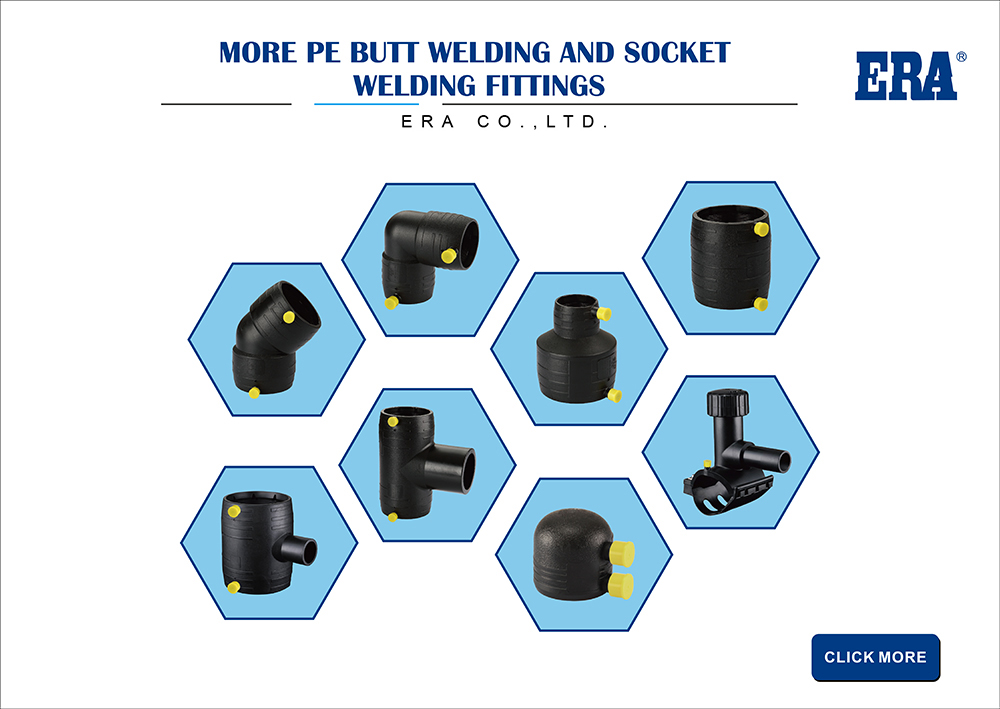
2. Classified according to construction methods and purposes: electric heating fusion fittings, hot fusion butt fittings, socket fittings, and steel plastic conversion joints.


 English