What are tee fittings used for in plumbing?
2023-10-09
Tee fitting is a key component of piping systems, they allow fluid to flow through the pipe and divert or merge in different directions. These fittings play an important role in a variety of industrial and commercial applications, from water supply systems to chemical plants to oil and gas transmission pipelines. Their design and performance are critical to ensuring the efficient operation of piping systems. Therefore, understanding the working principles, types and applications of tee fittings is essential knowledge in the field of piping engineering.
Tee fittings are piping elements, usually with one inlet and two outlets, that allow fluids to flow or divert in different directions. They are usually in a "T" or "Y" shape, which is why they are often referred to as T- or Y-tees. The basic function of a tee fitting is to direct fluid from one pipe to two or more different pipes or directions, allowing the fluid to flow freely through the piping system.
Among the types of tee fittings, there are several common types:
Reducing Tee: Reducing tees have branches of different diameters that allow fluid to be diverted from a large pipe to a smaller pipe. This type of tee fitting is useful in applications that require a gradual decrease in flow rate to minimize pressure loss and fluid fluctuations.
Straight Tee: A straight tee is a common type of tee fitting in which all branch pipes have the same diameter. It is often used where there is a need to divert fluid into two equal pipes, such as a T-split.
Female Tee: A female tee has an inlet and two outlets, one of which is usually male threaded for connection to other pipes or fittings. This type of tee fitting is commonly used in scenarios where accessories or other pipes need to be connected.
Main Materials for Tee Fittings
Tee fittings can be manufactured using a variety of materials, with the exact choice depending on the requirements of the application and environmental conditions. Some common materials include:
PVC (polyvinyl chloride): PVC tee fittings are typically used in low-pressure, non-corrosive fluid applications such as water supply systems and wastewater treatment. They are lightweight, economical and easy to install.
Stainless steel: Stainless steel tee fittings offer corrosion resistance and high strength for a variety of industrial and chemical applications, especially where a high degree of durability is required.
Copper: Copper tee fittings have good thermal conductivity and corrosion resistance and are commonly used in applications such as refrigeration and air conditioning systems.
Standards and Codes for Tee Fittings
Various international and industry standards and codes have been developed to ensure the quality and performance of tee fittings. These standards typically specify requirements for tee fittings in terms of dimensions, materials, manufacturing processes, test methods, and so on. For example, ASME (American Society of Mechanical Engineers) in the United States and EN (European Standard) in Europe have relevant standards to guide the design and manufacture of tee fittings.
In addition, specific standards may exist depending on the application area. For example, the food industry may require tee fittings that comply with FDA (Food and Drug Administration) standards to ensure that they do not produce harmful substances when in contact with food.
The function of tee fittings in a piping system cannot be underestimated, and their role is crucial. Not only do these fittings simply connect pipes together, but they also play multiple roles throughout the system, allowing for a more flexible and efficient operation of the piping system:
Diversion of fluid: When a piping system needs to direct fluid from one pipe to two or more different directions, tee fittings become an indispensable component. For example, imagine a water supply system that needs to direct water from one main line to multiple branch lines, which requires the use of tee fittings to accomplish this diversion operation.
Branching: enabling complex process control in piping systems. They can direct fluid to a main line and one or more branch lines, allowing for fluid distribution and centralized control. This is useful in a variety of industrial applications, such as in chemical plants, where tee fittings can be used to direct different chemicals to different reactors for precise process control.
Flow control: By adjusting the structure and design of tee fittings, different levels of fluid flow rate regulation can be achieved. This is important for applications that require flow control in piping systems to ensure that the desired fluid flow is available under different operating conditions.
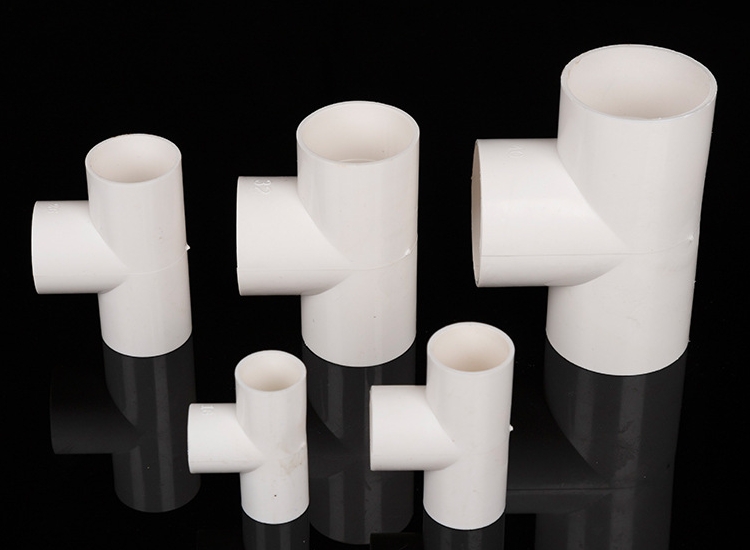
ERA Group is proud to offer a superior range of tee fittings designed to meet the needs of a variety of industrial and construction projects. Whether you need PVC tee fittings, reducer tees, straight tees, and more, we have a high-quality solution for you, and here are some of the notable features of our products:
High Quality: We are always committed to providing high quality products. Our tee fittings are made of high quality materials and undergo strict quality control and testing to ensure their outstanding durability and performance. Whether in terms of abrasion resistance or corrosion resistance, our products are capable of handling a variety of complex working environments.
Compliance with standards: As a responsible company, our products strictly follow international and industry standards. This not only ensures the safety and reliability of our products, but also provides you with reliable piping solutions that are widely used in a variety of projects. We adhere to the highest production standards to ensure that our customers receive impeccable quality.
Customer Satisfaction: Customer satisfaction is our company's most important concern. The high quality of our products and the excellence of the service we provide to our customers give them the confidence to consider our products as their first choice. We actively listen to our customers' feedback and continuously improve our products to ensure that they meet the evolving needs of the marketplace. Customer satisfaction is our relentless goal and our greatest motivation for continuous improvement.


 English