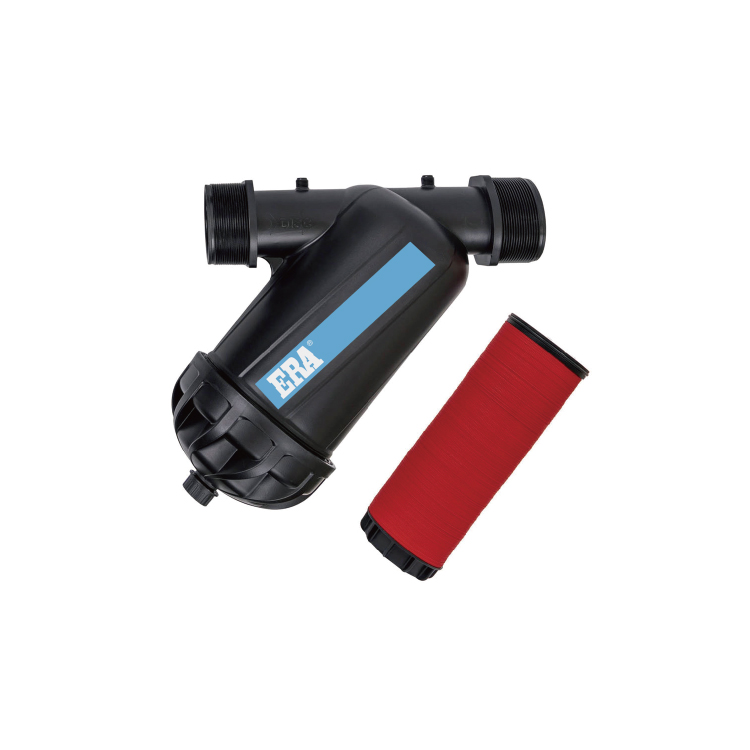
| MODEL | CONNECTIONS BSP/NPT | FILTRATION GRADES (mesh) | MAX FLOW (m3/h) | WORKING PRESSURE (bar) | FILTERING SURFACE (cm2) | WEIGHTS (kg) |
| F75YD | 2-1/2'' | 40/80/120 | 30 | 8 | 600 | 2.60 |
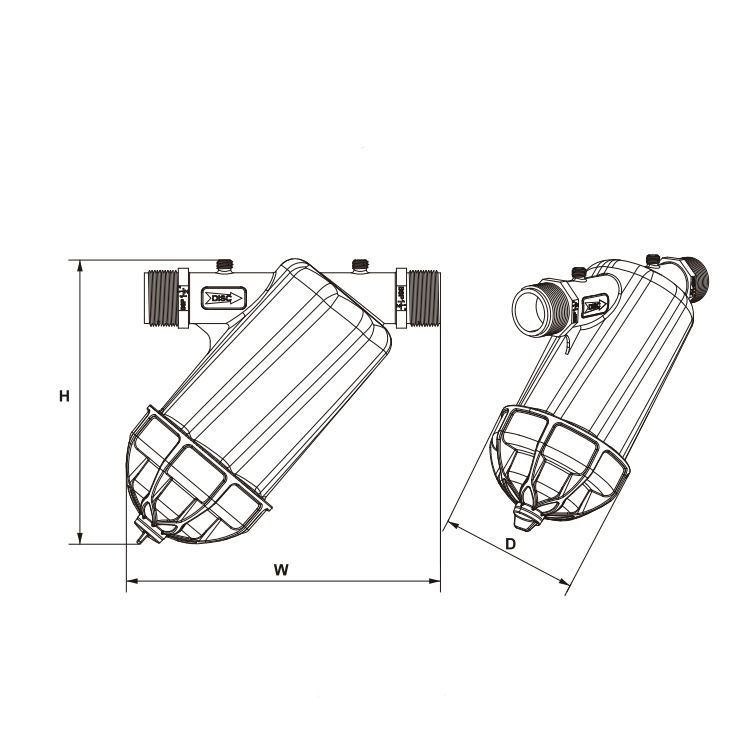
| MODEL | H(mm) | W(mm) | D(mm) |
| F75YD | 330 | 360 | 168 |
URBAN LANDSCAPE IRRIGATION
Provide clean recycling for urban public parks residential garden with cost efficient & energy saving solutions.
GOLF COURSE IRRIGATION
provide clean water supply and complete protection for golf course fairways and green irrigation equipment (sprayers, drip irrigation pipes, mist sprayers, etc.)
WATER TREATMENT
Provide the first step filteration for water treatment
ERA provides unique and comprehensive water filtration solutions to any agricultural and industrial application. Under ERA brand, there is a wide range of filters coming out of different filtering elements and materials. Furthermore, ERA irrigation filters are in accuracy levels and different flow rates. Meanwhile, automatic backwash filtration technology achieves simultaneous and continuous filtered water supply while discharging.
DISC FILTER:
Y type disc filters TX type disc filters
T type disc filters AGL disc filters
H type disc filters Automatic disc filters
UNIQUE TECHNOLOGY
ERA disc filter focused on multiple filtration grades, high effiency and large volume filtration advantage. We adopted Grooved Disc Design which is a combination of surface filtration and depth filtration . The discs are in a fully compressed state, the upper disc is attached to the lower disc and the grooves between the faces intersect together to form an infinite number of intercepting holes. When the water flows through, some larger particle impurities in the water are intercepted on the outer surface of the disc. The water flows into the disc filter to form the filtration of the water which reach a high effective filtration.
THE FILTRATION GRADE
ERA disc filter colorful & thin polypropylene discs with multiple filtration grades and provide various filters with flow rates & grade (20~400 micron) to satisfy different application needs.
YTYPE DISCFILTERS
The well designed structure makes it easy to clean and can be easily installed in a narrow space. Built-in pressure pipeline, Y type disc filter will efficiently filter out particles.
TYPICAL APPLICATION
Applied to low flow rate water filtering for household, agriculture irrigation, municipal garden irrigation.
FEATURE & ADVANTAGE
Manual cleaning
Compact structure available in narrow space
Threaded closure system, easy and safe
Innovative depth filter traps design retains large amounts of solids
Resistant to chemical products
Easy installation, easy maintenance
Auxiliary connection for drain & pressure
Preset 2 ports for connection pressure gauge
Gasket in the lid of the filter
Clean water supply methods for agricultural irrigation equipment
In modern agriculture, the healthy operation of irrigation equipment is directly related to the growth and yield of crops. Therefore, ensuring clean water supply for irrigation systems is particularly important. This not only ensures the normal operation of the equipment, but also extends its service life. This article will introduce several common clean water supply methods to help farmers better maintain irrigation equipment.
Cleaning of nozzles and nozzles
Sprinklers and nozzles are key components in irrigation systems, responsible for evenly spraying water onto crops. However, these small components are easily clogged by dust, weeds, or other substances, which can affect the spraying effect. To maintain the good working condition of the nozzle, it is recommended to regularly remove it, soak it in warm water for a period of time, and then gently brush it with a soft bristled brush. This can effectively remove blockages and restore the normal function of the nozzle and spray head. In addition, specialized cleaning solution can be used for deep cleaning to ensure that every detail is thoroughly processed.
Regularly flush the pipeline
Pipelines are important channels for transporting water sources, but after prolonged use, impurities such as dirt, sediment, or algae may accumulate inside, which not only affects water flow velocity but also leads to a decrease in water quality. For this, we need to regularly flush the pipeline. An effective method is to use a high-pressure water gun to forcefully flush the interior of the pipeline, removing the dirt attached to the inner wall. Another method is to open all nozzles or outlets during the operation of the irrigation system, allowing water to flow at high speed in the pipeline for a period of time, and using the impact force of the water flow itself to achieve self flushing effect. The combination of these two methods can significantly improve the cleanliness of pipelines.
Filter water source
To further ensure the water quality entering the irrigation system, we can install suitable filters at the inlet of the water supply. There are various types of filters available on the market, such as mesh filters, sand filters, and disc filters. Filter screen filters are mainly used to intercept impurities from larger particles; Sand filters are good at filtering small particles and organic matter; And disc filters perform well in removing algae and microorganisms. Reasonably combining different types of filters based on the specific situation of the actual irrigation water source can minimize the impurity content in the water and ensure the purity of the irrigation water.
Check and clean the water tank
If the irrigation system is equipped with a water storage tank, regular inspection and maintenance of the tank is also an essential step. Firstly, it is necessary to carefully inspect the interior of the water tank for any dirt, algae, or other pollutants, and promptly remove them. Secondly, it is important to clean the sediment at the bottom of the water tank to prevent it from being carried back into the irrigation system. Finally, ensure that the water tank has good sealing performance to prevent external impurities from entering and contaminating the water source. Through the above measures, the overall hygiene condition of the water storage tank can be effectively improved, providing a safer and more reliable water source for irrigation
In short, by scientifically and reasonably adopting the above-mentioned clean water supply methods, not only can irrigation equipment be effectively prevented from malfunctioning due to pollution, but also the utilization rate of water resources can be significantly improved, promoting the improvement of agricultural production efficiency. I hope every farmer friend can take it seriously and work together to protect this green land that nourishes life.
Improving agricultural water efficiency is one of the keys to achieving sustainable agricultural development. Here are several effective methods that can help farmers make better use of water resources and enhance irrigation effects:
Advanced Irrigation Techniques
- Drip Irrigation: Through a pipeline system, water is directly delivered to the plant roots, reducing evaporation and seepage losses. Suitable for high-value crops such as fruit trees and vegetables.
- Micro-Sprinkler Irrigation: Uses tiny sprinklers to spray water in fine, uniform droplets, effectively controlling water volume. Ideal for flowers and greenhouse planting.
- Smart Irrigation Systems: Utilize sensors to monitor soil moisture, weather conditions, and other parameters to automatically control irrigation timing and water volume, avoiding over- or under-irrigation and improving water resource utilization.
Improved Irrigation Management
- Reasonable Planning of Irrigation Time: Based on crop water requirements and local climate characteristics, arrange irrigation times reasonably, preferably in the morning or evening, to reduce water loss due to evaporation.
- Rotational Irrigation System: Implement a rotational irrigation system where different plots are irrigated alternately, ensuring each plot receives sufficient water while avoiding waste caused by excessive water use at once.
- Regular Equipment Checks and Maintenance: Conduct regular checks on the working status of irrigation equipment, promptly fixing issues like leaks and blockages to ensure normal operation and reduce water wastage.
Optimized Water Source Management
- Rainwater Collection and Utilization: Construct reservoirs or dams to collect rainwater for irrigation, especially during dry seasons to alleviate water pressure.
- Wastewater Recycling: Treat wastewater from livestock farming and domestic use for reuse in farmland irrigation, saving fresh water resources and reducing environmental pollution.
Promote Water-Saving Agricultural Models
- Conservation Tillage: Adopt no-till or reduced tillage practices to minimize soil disturbance, maintain stable soil structure, and enhance water retention capacity.
- Mulching: Cover the soil surface with straw, plastic film, and other materials to reduce water evaporation and keep the soil moist.
- Drought-Resistant Varieties: Select crop varieties with strong drought resistance that adapt to local climate conditions, reducing the need for water resources.
Enhance Education and Training
- Technical Training: Organize farmers to participate in training courses on water-saving irrigation techniques, learning the latest water-saving technologies and management methods to improve practical skills.
- Publicity and Education: Spread awareness about the importance of water conservation through various channels, enhancing farmers' consciousness of water conservation and encouraging their active participation in water-saving actions.
Policy Support and Incentive Measures
- Financial Subsidies: Governments can provide financial subsidies to encourage farmers to purchase and use water-saving irrigation equipment and technologies.
- Technical Support: Establish specialized service institutions to provide farmers with technical consultation and services, helping them solve problems encountered in the process of water conservation.
By comprehensively applying these various measures, agricultural water efficiency can be significantly improved, promoting the sustainable development of agricultural production. We hope that every farmer will take this seriously and work together to protect this green land that nourishes life.
Protective measures for agricultural irrigation equipment
In modern agricultural production, irrigation equipment is an important tool to ensure crop growth and yield increase. It is crucial to take a series of protective measures to ensure the normal operation of these devices and extend their service life. This article will explore how to ensure the efficient operation of agricultural irrigation equipment through regular inspections and maintenance.
Firstly, regular inspections of key components such as water pumps, valves, and nozzles are necessary. As the core component of the irrigation system, the operation sound and abnormal vibration of the water pump need to be closely monitored. If abnormal noise or excessive vibration is found in the water pump, it should be stopped for inspection in a timely manner, and the problem should be identified and repaired or replaced. The flexibility of valve opening and closing also needs to be regularly tested to ensure no water leakage. Whether the spraying angle and range of the nozzle meet the requirements is equally important. If nozzle blockage or angle deviation is found, it should be cleaned and adjusted immediately to ensure uniform irrigation.
Secondly, circuit inspection is particularly important for electric equipment. It is necessary to carefully check whether the wires are intact, whether the plugs are loose, and whether the circuits are connected properly. Circuit faults may cause equipment to fail to start or operate stably, and even lead to safety accidents. Therefore, regularly checking the circuit to ensure that all connections are secure and reliable is a key step in ensuring the safe operation of the equipment.
In addition, keeping the equipment clean is also an important aspect that cannot be ignored. Irrigation equipment is prone to accumulating sediment and impurities during use, which not only affects the efficiency of the equipment but may also accelerate its wear and tear. Therefore, regularly cleaning the surface and interior of the equipment to maintain its cleanliness can effectively extend its service life.
Finally, professional training for operators is also an important factor in ensuring the normal operation of equipment. Operators should be familiar with the operating procedures and maintenance methods of irrigation equipment, and master basic troubleshooting skills. By providing regular training, the skill level of operators can be improved to better cope with various problems that arise during equipment operation.
In summary, regular inspection and maintenance of agricultural irrigation equipment can effectively ensure its normal operation, extend its service life, and thus improve the efficiency and benefits of agricultural production. I hope every farmer friend can take it seriously and work together to protect this green land that nourishes life.
In order to ensure the normal operation and prolong the service life of agricultural irrigation equipment, a series of protective measures need to be taken:
Regularly check the operating status of equipment
Inspect key components such as water pumps, valves, and nozzles to see if they are functioning properly. For example, whether the operating sound of the water pump is normal and whether there is any abnormal vibration; Is the valve flexible in opening and closing, and is there any leakage; Whether the spraying angle and range of the nozzle meet the requirements, etc. If any abnormal situation is found, repair or replace it in a timely manner to ensure the normal operation of the equipment.
Check the circuit of the equipment (for electric equipment), including checking whether the equipment wires are intact, whether the plugs are loose, and whether the circuit is connected properly. Circuit faults may cause equipment to fail to start or operate stably, and even lead to safety issues.
Keep the equipment dry
Agricultural irrigation equipment is prone to moisture, and the invasion of moisture may cause rusting, corrosion, or electrical failure of the equipment. Measures such as moisture-proof agents and sunshades can be used to prevent water vapor from seeping into the interior of the equipment, reduce the humidity level of the equipment, and lower the risk of equipment failure.
When the equipment is not in use, it should be stored in a dry and ventilated place. For some detachable components, they can be disassembled and stored separately, and protective measures should be taken.
Timely replacement of vulnerable parts
Some vulnerable parts in agricultural irrigation equipment, such as sealing rings and belts, may experience wear and aging after a period of use. Regular inspection and timely replacement of these vulnerable parts can ensure the normal operation of the equipment and avoid malfunctions. For example, aging of the sealing ring may lead to water leakage, and belt wear may affect the power transmission of the equipment.
Establish a comprehensive maintenance system and archives
Establish a regular inspection system to conduct detailed checks on irrigation water sources, diversion channels, pump stations, irrigation equipment, etc., and promptly identify and resolve potential safety hazards. At the same time, develop a maintenance plan for the equipment, specifying the maintenance cycle, content, and responsible persons.
Establish a sound management system for irrigation project archives, timely record and archive various data related to project operation, such as equipment maintenance records, operating time, and fault situations. These data can provide reference for later evaluation and improvement, helping to optimize equipment maintenance and management strategies.
Reasonably design irrigation system
In the planning and design stage of irrigation systems, factors such as terrain, soil type, and crop water demand should be fully considered to ensure a reasonable layout of the irrigation system. For example, designing appropriate pipeline slopes and nozzle layouts based on the slope and elevation differences of the terrain to avoid water accumulation or uneven irrigation.
Choose appropriate irrigation equipment and techniques, and adopt suitable irrigation methods such as drip irrigation, sprinkler irrigation, and flood irrigation according to different crops and planting areas. At the same time, consideration should be given to the compatibility and scalability of the equipment, so that it can be easily operated when upgrades or modifications are needed in the future.
Characteristics and Applicable Scenarios of Various Agricultural Irrigation Equipment
Different types of agricultural irrigation equipment have their own characteristics and applicable scenarios:
Flood irrigation
characteristic
Easy to operate, no need for complex equipment and technology, just need to build embankments and ditches in the farmland, and introduce water into the farmland.
The amount of irrigation water is large, which can make the soil fully moist, but it is also prone to waste of water resources due to significant evaporation and leakage losses.
It has a certain impact on soil structure, which may cause soil compaction and affect soil aeration and permeability.
Applicable scenarios: Suitable for large-scale farmland with flat terrain and good soil permeability, as well as crops that do not require high irrigation accuracy, such as some grain crops (wheat, rice, etc.) that can be irrigated through flood irrigation in areas with relatively abundant water resources. But with the increasing scarcity of water resources and the increasing demand for irrigation efficiency, the application scope of flood irrigation is gradually limited.
Gully irrigation
characteristic
Opening trenches between crop rows allows water to flow in the trench and infiltrate to both sides through soil capillary action, which is more water-saving than flood irrigation.
Being able to control the amount and direction of irrigation water, the damage to soil structure is relatively small.
But it requires manual trenching, which is labor-intensive, and the uniformity of irrigation is greatly affected by factors such as the depth, spacing, and slope of the trench.
Applicable scenarios: commonly used for irrigation in orchards, vegetable gardens, and some wide row crops such as cotton, corn, etc. It can also be well applied in farmland with a certain slope in the terrain. By designing the direction and slope of the ditch reasonably, a good irrigation effect can be achieved.
sprinkling irrigation
characteristic
Use a nozzle to spray water into the air, forming small droplets that fall to the ground like rain. This method can increase air humidity and improve the microclimate in the fields.
Uniform spraying can better meet the water requirements of crops, and the spraying intensity and time can be adjusted according to the growth stage and water demand of crops.
Compared to flood irrigation and ditch irrigation, sprinkler irrigation has a significant water-saving effect, generally saving 30% to 50% of water. However, the investment cost of sprinkler irrigation equipment is relatively high, requiring a certain amount of energy (such as electricity or fuel) to drive the water pump and nozzle operation, and the uniformity of spraying will be affected in windy conditions.
Applicable scenarios: Widely applicable to various crops, especially large-scale field crops (such as wheat, corn, soybeans, etc.), orchards, lawns, and flower planting. For farmland with complex terrain and large undulations, sprinkler irrigation can also adapt well. By adjusting the height and angle of the nozzle, different terrains can be irrigated.
Drip irrigation
characteristic
Water slowly drips into the soil near the roots of crops through a dropper, which is currently one of the most water-saving irrigation methods, with a water-saving efficiency of up to 50% -80%.
It can accurately control the amount of irrigation water and fertilizer (if drip irrigation and fertilization integrated technology is used), directly delivering water and nutrients to crop roots, improving fertilizer utilization efficiency, and reducing nutrient loss.
The operating pressure of drip irrigation systems is relatively low, and the requirements for pipelines and equipment are relatively low, resulting in a longer service life. However, the drip heads of drip irrigation systems are prone to clogging and require high water quality, requiring the installation of effective filtration equipment; At the same time, the initial investment cost of drip irrigation systems is relatively high, and if the layout is not reasonable, it may result in some crop roots not being fully irrigated.
Applicable scenarios: Suitable for irrigation of various horticultural crops (such as vegetables, flowers, fruit trees, etc.), especially in arid areas or areas with extreme water scarcity. Drip irrigation is an ideal irrigation method for some cash crops that have strict requirements for water and nutrients, such as grapes, strawberries, etc.
What types of pipelines do rigid and flexible pipelines commonly mentioned in municipal pipeline engineering refer to? Is steel pipe considered a rigid pipeline or a flexible pipeline? Below, according to the definition in GB 50268-2008"Code for Construction and Acceptance of Water Supply and Drainage Pipeline Engineering", we will introduce it to you.
1、 What is a rigid pipeline?
● Definition
Rigid pipelines mainly rely on the strength of the pipe material to support external forces, and their deformation is very small under external loads. The failure of pipelines is due to the control of pipe wall strength.
Characteristics of rigid pipelines:
——High strength mainly relies on the strength of its material itself to withstand external loads and pressures, rather than relying on the soil or other environmental factors around the pipeline.
——Low deformation: Under the action of force or load, the deformation of rigid pipelines is very limited and usually maintains a relatively fixed shape.
——Failure of pipe wall strength control: The structural stability of a pipeline is mainly determined by the strength of the pipe wall. The failure of a pipeline is usually due to insufficient pipe wall strength, rather than excessive deformation. The strength of the pipe wall is a key factor in design and use.
——Strong impact resistance: It has good impact resistance and durability, can resist mechanical damage and external impact, and is suitable for high-pressure and high-strength engineering environments.
——Low environmental adaptability: Due to the low deformation characteristics of pipelines, they have poor adaptability to environmental changes such as foundation settlement and earthquakes, and are easily damaged under these conditions.
Common types of rigid pipelines:
——Reinforced concrete pipeline is a pipeline composed of steel bars and concrete, where steel bars provide tensile strength and concrete provides compressive strength. It is widely used in municipal and infrastructure projects that can withstand high pressure.
——Pre stressed concrete pipes are prestressed concrete pipes that apply pre stress to the steel bars before pouring concrete, so that the pipes can better resist external loads and internal pressures during use, thereby reducing cracks and deformation.
——On the basis of prestressed concrete pipelines, steel cylinders are added to the inner layer of prestressed steel cylinder concrete pipelines to enhance the pipeline's anti-seepage and compression resistance. It is commonly used in high-pressure water and gas transmission projects.
2、 What is Flexible Pipeline?
● Definition
Pipelines that deform significantly under external loads are mostly balanced by the elastic resistance generated by the soil on both sides of the pipeline, and the failure of the pipeline is usually caused by deformation rather than damage to the pipe wall.
Characteristics of flexible pipelines:
——Strong adaptability: Flexible pipelines can adapt to geological and structural changes such as ground subsidence and building subsidence, so the requirements for the foundation are relatively low during construction.
——Good flexibility: Flexible pipelines can bend and bypass obstacles during installation, making them suitable for complex terrains and pipeline layouts.
——Bearing capacity: Flexible pipelines undergo significant deformation when subjected to external loads, but balance vertical loads through the elastic resistance of the soil, mainly relying on the soil's support for the pipeline.
——Seismic performance: Flexible pipelines have good seismic performance and can maintain the stability of pipeline systems in disasters such as earthquakes.
Common types of flexible pipelines:
——Steel pipes mainly include stainless steel pipes, welded steel pipes, seamless steel pipes, galvanized steel pipes, as well as alloy steel pipes, coated steel pipes, etc.
——According to the GB 50268-2008 standard, chemical building materials pipes refer to fiberglass pipes or fiberglass reinforced thermosetting plastic pipes (referred to as fiberglass pipes), rigid polyvinyl chloride pipes (UPVC), polyethylene pipes (PE), polypropylene pipes (PP), and their steel plastic composite pipes.
——Ductile iron pipes with flexible interfaces refer to pipes made of ductile iron material and connected by flexible connectors such as rubber rings and flexible joints. Ductile iron has excellent mechanical properties and corrosion resistance, while flexible connections enable pipelines to adapt to certain displacements during foundation changes or vibrations, reducing potential damage caused by rigid connections.


 English